GLM-4.6 and Minimax-M2 represent two of the most capable new-generation language models in the open-source LLM ecosystem. They target reliability, efficiency, and developer usability, from coding support to multi-step task execution to production-facing assistants. Each model is pushing toward ‘fast, capable, and affordable’ in its own way. So which one actually fits your workflow?
In this article, we’ll examine their key strengths, contrasts, cost, and real-world applications to help you determine which model best suits your goals.
GLM-4.6 vs Minimax-M2: Basics and Benchmark
| Feature | GLM 4.6 | Minimax M2 |
|---|---|---|
| Parameter | 355B with 32B activated | 230B with 10B activated |
| Architecture | MoE | MoE |
| Context Window | 200K Tokens | 204K Tokens |
| Open Source | Yes | Yes |
| Thinking Mode | Reasoning + Non-Reasoning | Think + Non-Think |
| Benchmark | Category | GLM-4.6 | Minimax-M2 |
|---|---|---|---|
| Terminal-Bench Hard | Agentic Coding & Terminal Use | 23% | 24% |
| 𝜏²-Bench Telecom | Agentic Tool Use | 71% | 87% |
| AA-LCR | Long Context Reasoning | 54% | 61% |
| Humanity’s Last Exam | Reasoning & Knowledge | 13.3% | 12.5% |
| MMLU-Pro | Reasoning & Knowledge | 83% | 82% |
| GPQA Diamond | Scientific Reasoning | 78% | 78% |
| LiveCodeBench | Coding | 70% | 83% |
| SciCode | Coding | 38% | 36% |
| IFBench | Instruction Following | 43% | 72% |
| AIME 2025 | Competition Math | 86% | 78% |
1. Reasoning & Knowledge
In reasoning and knowledge-intensive scenarios, GLM-4.6 demonstrates slightly stronger consistency and structure. Its responses tend to follow logical chains more clearly, maintain factual precision, and present ideas in a well-organized way. This makes it especially suitable for analytical writing, research assistance, or complex decision-making workflows. Minimax M2, while close in overall reasoning ability, focuses more on agility and efficiency — often producing concise, practical answers rather than elaborated reasoning paths.
2. Scientific Reasoning
When handling scientific or technical questions, both models show a comparable level of understanding. They can interpret formulas, theoretical contexts, and experiment-style problems with similar accuracy. However, GLM-4.6 tends to offer more stable and reproducible reasoning, while M2 leans toward more flexible problem-solving patterns, adapting faster to new or ambiguous prompts.
3. Coding & Technical Execution
Minimax M2 performs better when executing practical coding instructions, such as editing files, running scripts, or performing iterative improvements. It behaves more like a developer assistant that understands intent and follows through efficiently.
In contrast, GLM-4.6 is stronger in logical consistency and correctness of algorithms, making it well-suited for code explanation, debugging logic, or reasoning about system design decisions.
4. Agentic Use & Tool Interaction
Minimax M2 shows a clear advantage in agent-style usage. It handles tool invocation, command execution, and multi-step planning with greater reliability. This gives it a stronger fit for agent frameworks, API orchestration, and workflow automation.
GLM-4.6, although slightly less aggressive in tool use, provides steadier output quality when reasoning about intermediate steps, which benefits scenarios requiring validation or structured output.
5. Long-Context & Instruction Following
In tasks requiring extended context or detailed step-by-step comprehension, Minimax M2 outperforms by maintaining coherence and following complex instructions more faithfully. It manages long documents or multi-turn dialogues with a smooth, human-like flow, making it ideal for summarization, long-form writing, or project automation.
By comparison, GLM-4.6 is more cautious and structured, prioritizing factual alignment and clarity even when handling large inputs — a trait that benefits academic, legal, or enterprise documentation tasks.
6. Mathematical & Symbolic Tasks
When dealing with mathematical reasoning or symbolic logic, GLM-4.6 stands out with greater precision and interpretability. It handles problem decomposition, symbolic manipulation, and formula reasoning with stronger internal consistency. This gives it an edge for quantitative research, competitive problem-solving, or analytic-heavy engineering use cases where accuracy matters more than execution speed.
Takeaway
- GLM-4.6 excels at sustained reasoning, precise coding, and refined communication. It behaves like a deliberate, context-aware problem solver ideal for research, technical writing, and agent frameworks that require reasoning clarity and tool reliability.
- Minimax-M2 is an agent-native model designed for execution speed, robustness, and real-world adaptability. It feels like a developer assistant that does rather than discusses—ideal for production pipelines, code orchestration, and long-context agents that value throughput and responsiveness.
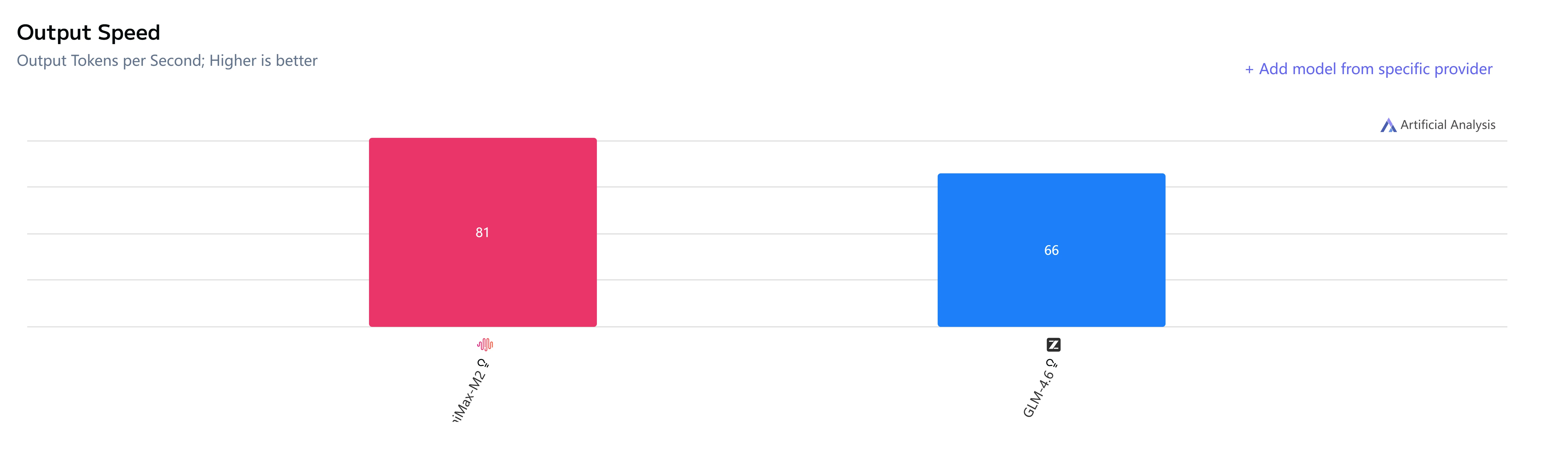
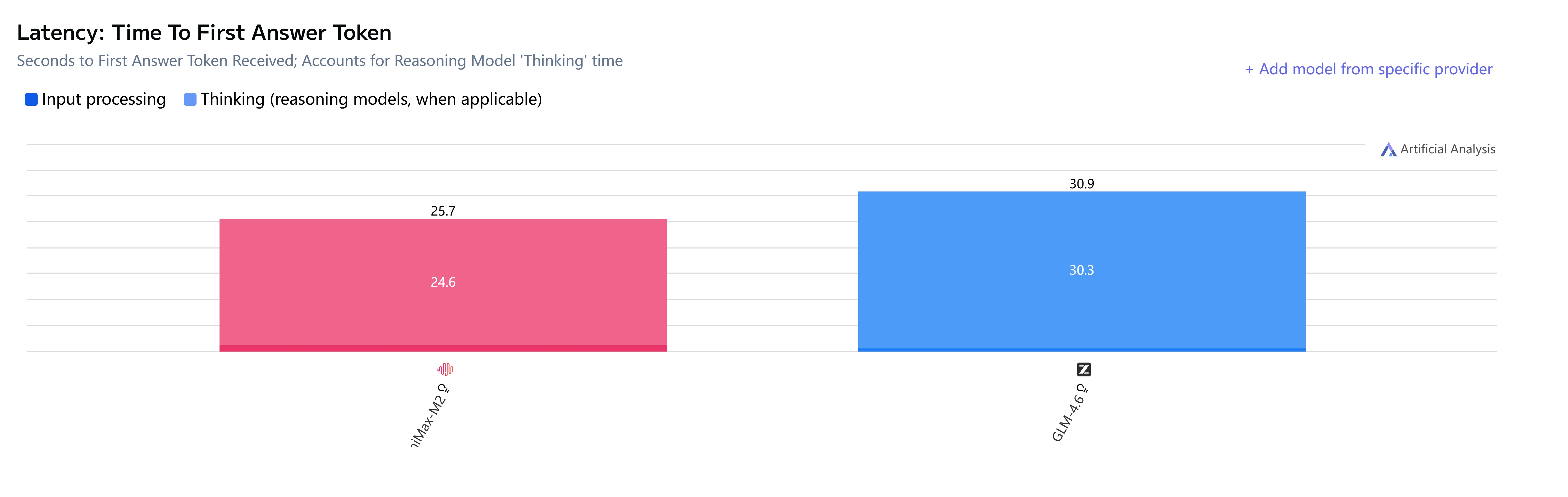
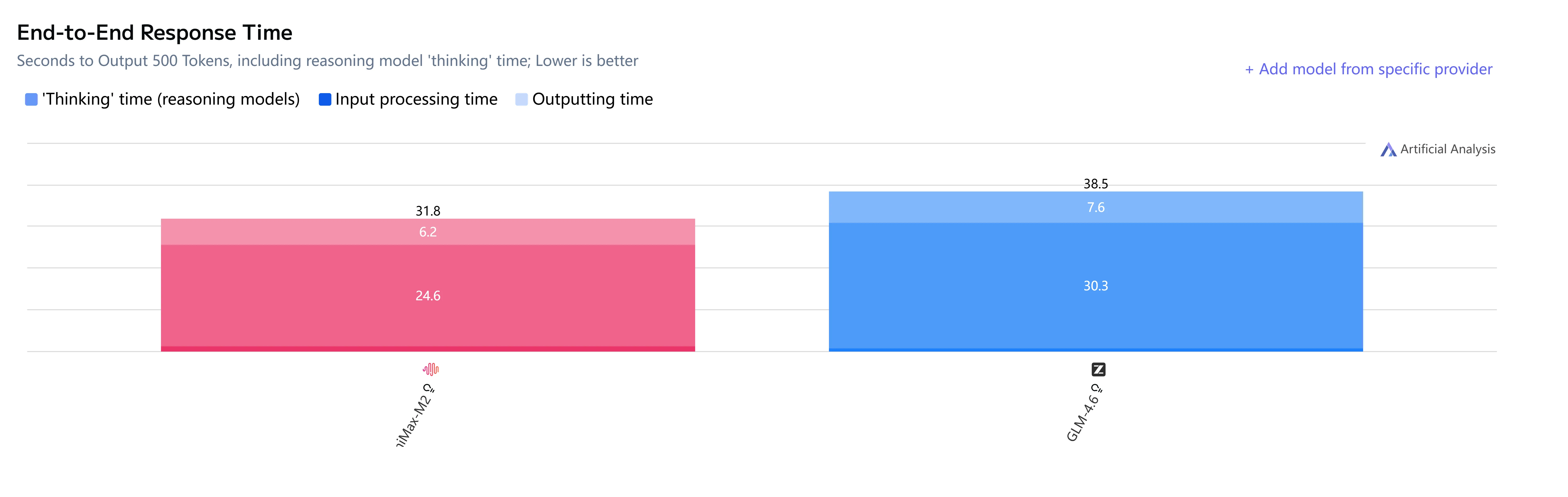
GLM-4.6 vs Minimax-M2: Speed and Latency
GLM-4.6 vs Minimax-M2: Use Cases
Both models perform impressively but reflect different design philosophies — GLM-4.6 is the structured thinker, while Minimax-M2 is the adaptive executor.
Their strengths manifest in distinct real-world scenarios:
GLM-4.6: Structured Reasoning and Long-Form Intelligence
GLM-4.6 shines where accuracy, reasoning clarity, and contextual stability define value.
Its 200K-token window and refined language alignment make it ideal for tasks that demand sustained thought and interpretability.
- Analytical research workflows: synthesizing insights from long reports, multi-PDF datasets, or legal/financial documents with cross-reference logic.
- Technical writing & documentation: generating structured reports, architecture overviews, or user manuals that require consistency in tone and factual precision.
- Complex code reasoning: explaining algorithms, refactoring large projects, or optimizing system design while maintaining coherent rationale.
- Context-aware assistants: powering dialogue systems or educational bots that must stay logically consistent across hundreds of turns.
Minimax-M2: Execution, Agility, and Agentic Performance
Minimax-M2 thrives in environments where speed, autonomy, and adaptability take priority.
Its agent-native architecture enables seamless tool use, making it ideal for dynamic, multi-step workflows.
- Developer automation: performing multi-file edits, dependency fixes, or CI/CD debugging in terminal or IDE contexts with low latency.
- Agentic retrieval tasks: running browse-and-synthesize pipelines that locate sources, extract data, and verify results autonomously.
- Workflow orchestration: coordinating chained actions across shell, browser, and code runners for business or data automation.
- Scalable deployment: serving as a cost-efficient, high-throughput engine for production-level agents or collaborative coding platforms.
GLM-4.6 vs Minimax-M2: Pricing
| Model | Input Price (/1M Tokens) | Output Price (/1M Tokens) |
| GLM-4.6 (via Novita AI) | $0.6 | $2.2 |
| Minimax-M2 (via Novita AI) | $0.3 | $1.2 |
Novita AI supports both GLM-4.6 and MiniMax-M2 through its REST API, offering advanced reasoning, extended context, and high coding efficiency.
How to Access GLM-4.6 or Minimax-M2 on Novita AI
Option 1: Using API
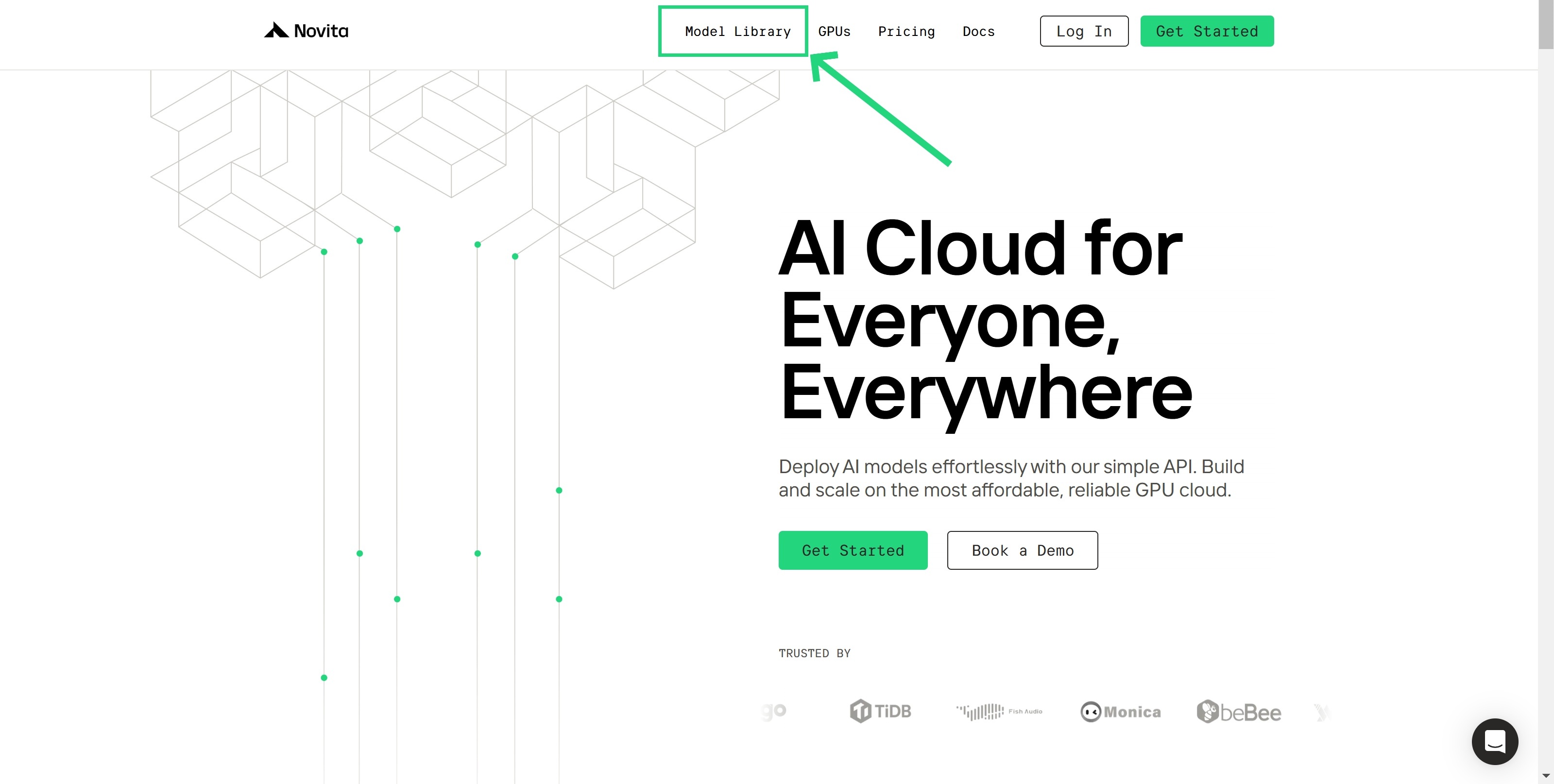
Step 1: Log In and Access the Model Library
Log in to your account and click on the Model Library button.
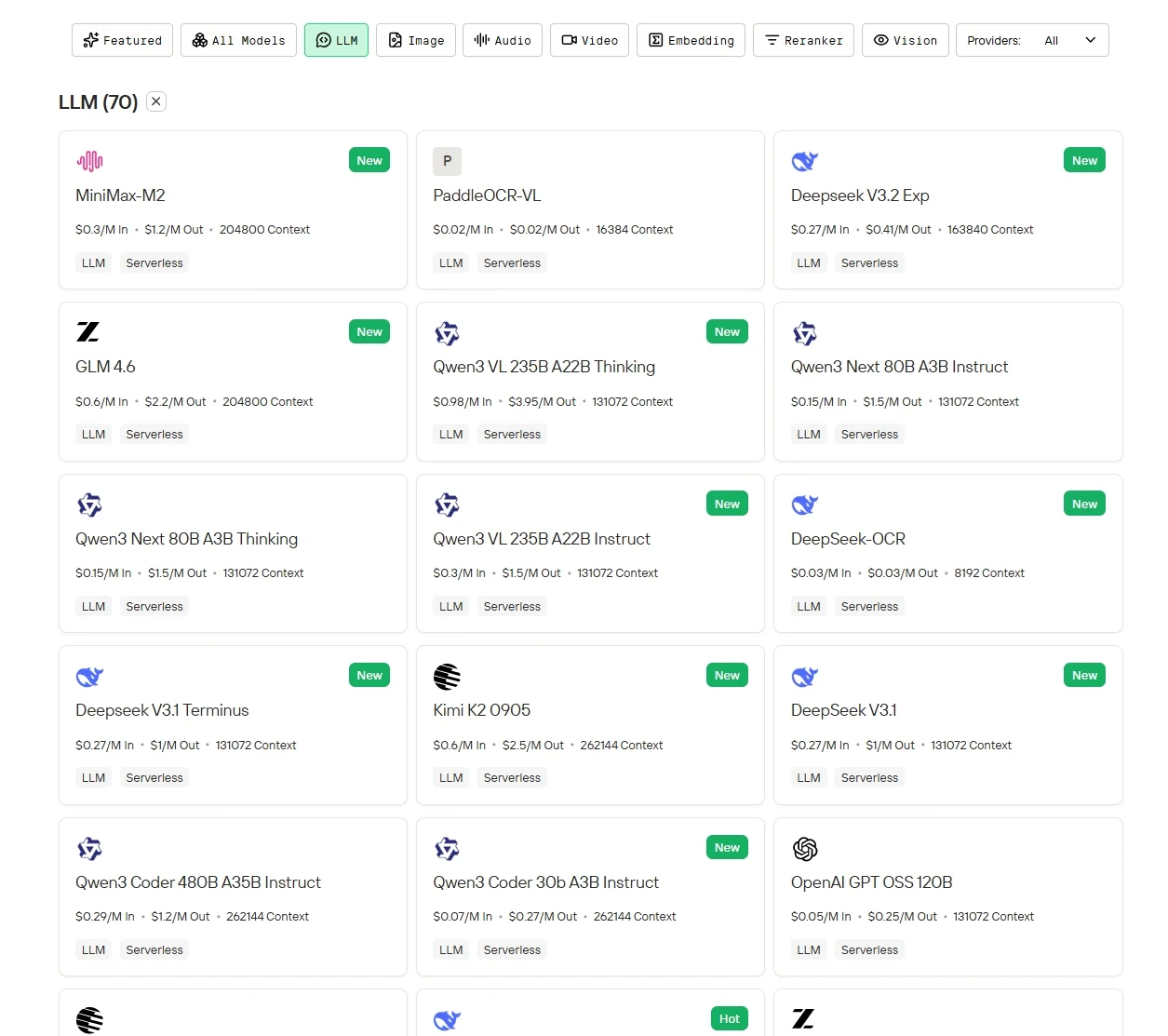
Step 2: Choose Your Model
Browse through the available options and select the model that suits your needs.
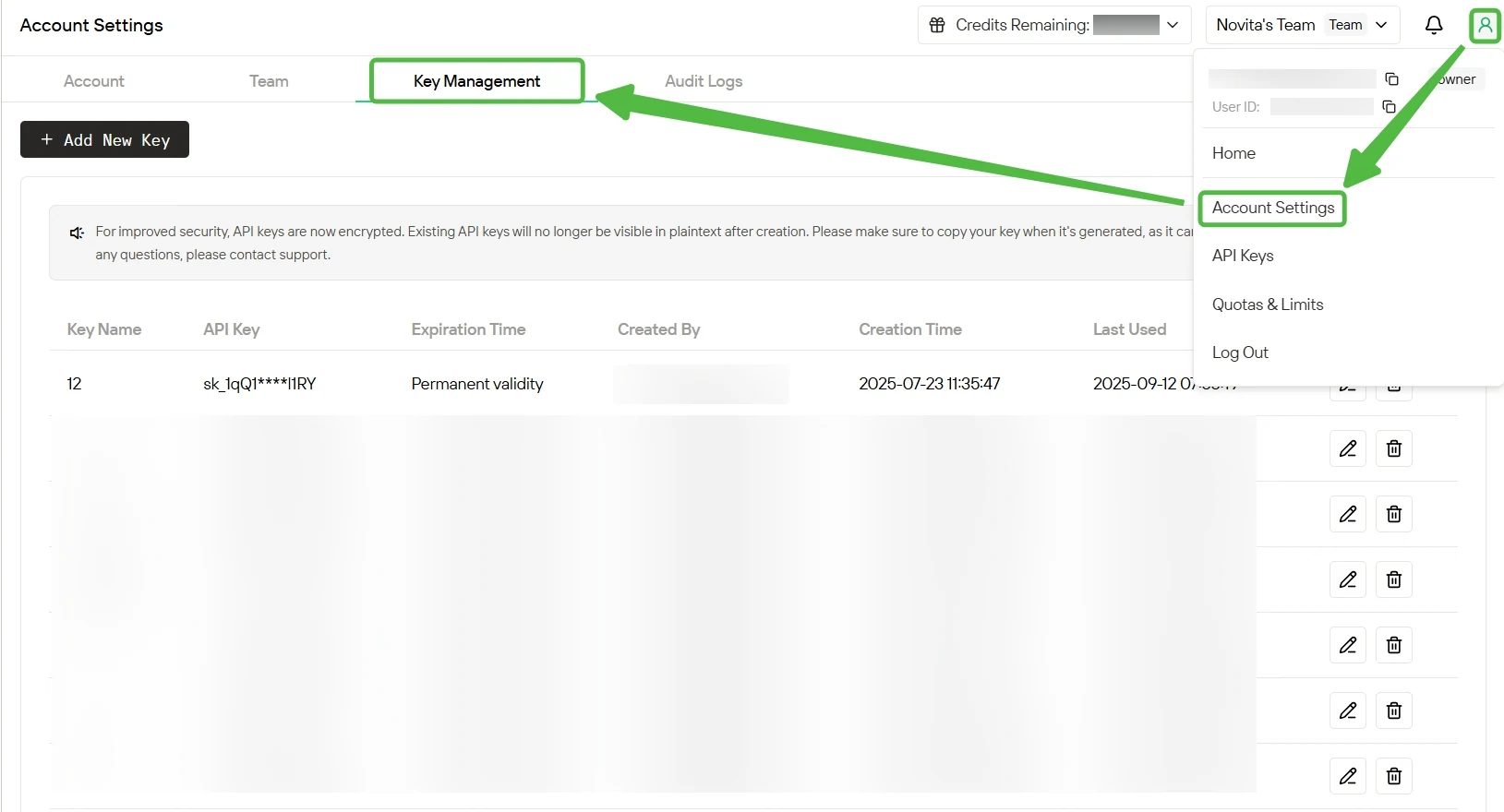
Step 3: Get Your API Key
To authenticate with the API, we will provide you with a new API key. Entering the “Settings“ page, you can copy the API key as indicated in the image.
Step 4: Install the API (GLM 4.6 as Example)
Install API using the package manager specific to your programming language.
After installation, import the necessary libraries into your development environment. Initialize the API with your API key to start interacting with Novita AI LLM. This is an example of using chat completions API for python users.
from openai import OpenAI

client = OpenAI(
    api_key="<Your API Key>",
    base_url="https://api.novita.ai/openai"
)

response = client.chat.completions.create(
    model="zai-org/glm-4.6",
    messages=[
        {"role": "system", "content": "You are a helpful assistant."},
        {"role": "user", "content": "Hello, how are you?"}
    ],
    max_tokens=131072,
    temperature=0.7
)

print(response.choices[0].message.content)
Option 2: Multi-Agent Workflows with OpenAI Agents SDK
Build sophisticated multi-agent systems leveraging DeepSeek-V3.1’s dual-mode capabilities:
- Plug-and-Play Integration: Use DeepSeek V3.1 in any OpenAI Agents workflow
- Advanced Agent Capabilities: Support for handoffs, routing, and tool integration
- Scalable Architecture: Design agents that leverage DeepSeek V3.1’s capabilities
Option 3: Connect with Other Third-Party Platform
Development Tools: Seamlessly integrate with popular IDEs and development environments like Cursor, Trae, Qwen Code, and Cline through Novita AI’s API, which is fully OpenAI-compatible. In addition, the GLM-4.6 provided by Novita AI is also Anthropic-compatible, making it possible to integrate directly within Claude Code.
Orchestration Frameworks: Connect with LangChain, Dify, CrewAI, Langflow, and other AI orchestration platforms using official connectors.
Hugging Face Integration: Novita AI serves as an official inference provider of Hugging Face, ensuring broad ecosystem compatibility.
Frequently Asked Questions
What is the main difference between GLM-4.6 and Minimax-M2?
GLM-4.6 focuses on advanced reasoning and long-context performance, while Minimax-M2 emphasizes practical efficiency and conversational stability.
Is GLM-4.6 suitable for coding and software engineering?
Yes. GLM-4.6 handles complex multi-file projects and structured debugging better than most open-weight models, making it a solid choice for developers.
What makes Minimax-M2 ideal for fast applications?
Minimax-M2 uses a Mixture-of-Experts (MoE) design that activates only 10B parameters per query, allowing near-real-time responses with minimal latency for chatbots and automation tasks.
Novita AI is an AI cloud platform that offers developers an easy way to deploy AI models using our simple API, while also providing an affordable and reliable GPU cloud for building and scaling.