Key Highlights
Kimi K2 Strengths:
Overwhelming Cost Advantage: Extremely low API prices make it highly economical.Elite Reasoning Power: Superior performance in complex math and science problems.
Claude 4 Sonnet Strengths:
Leading Versatility & Capacity: Its 200k token window enables broad use cases for long-document analysis.
Solid Generalist Abilities: Strong and stable performance on general knowledge and key coding benchmarks.
If you’re looking to try Kimi K2 on your own use cases — Upon registration, Novita AI provides a $0.5 credit to get you started!
Basic Introduction of Model
Kimi K2
Kimi K2 is a breakthrough large-scale language model developed by Moonshot AI, released in July 2025. It features an innovative Mixture-of-Experts (MoE) architecture with 1 trillion total parameters and 32 billion parameters activated per forward pass, enabling efficient scaling and high performance. Kimi K2 is meticulously optimized for agentic intelligence, meaning it can autonomously plan, reason, use tools, and synthesize code with multi-step problem-solving capabilities. Also, its support for function calling also makes it a powerful tool for building automated agents and workflows.
Key Features and Architecture
- Architecture: MoE with 384 experts, selecting 8 per token during inference to balance efficiency and capability.
- Parameters: 1 trillion total, 32 billion active at a time.
- Context Window: 128K tokens.
- Training: Trained on 15.5 trillion tokens using Moonshot’s proprietary MuonClip optimizer to maintain training stability.
- Languages: Primarily optimized for Chinese and English.
- Disk Space: Full model requires approximately 1.09 TB.
Claude 4 Sonnet
Claude 4 Sonnet is Anthropic’s mid-size language model, designed to balance performance and cost-effectiveness for a wide range of applications, including content generation, support bots, and everyday development tasks. Claude 4 Sonnet significantly enhances the capabilities of its predecessor, Sonnet 3.7, excelling in both coding and reasoning tasks with improved precision and controllability.
Key Features and Architecture
- Architecture: Dense Transformer model (non-MoE) using large-scale dense parameterization.
- Training Focus: Emphasizes safety, alignment, and steerability alongside general-purpose natural language understanding and generation.
- Capabilities: Strong in conversational AI, multi-step reasoning, summarization, coding assistance, and ethical awareness.
- Languages: Mainly English optimized, with strong multilingual capabilities.
- Context Length: 200k tokens.
Benchmark Comparison
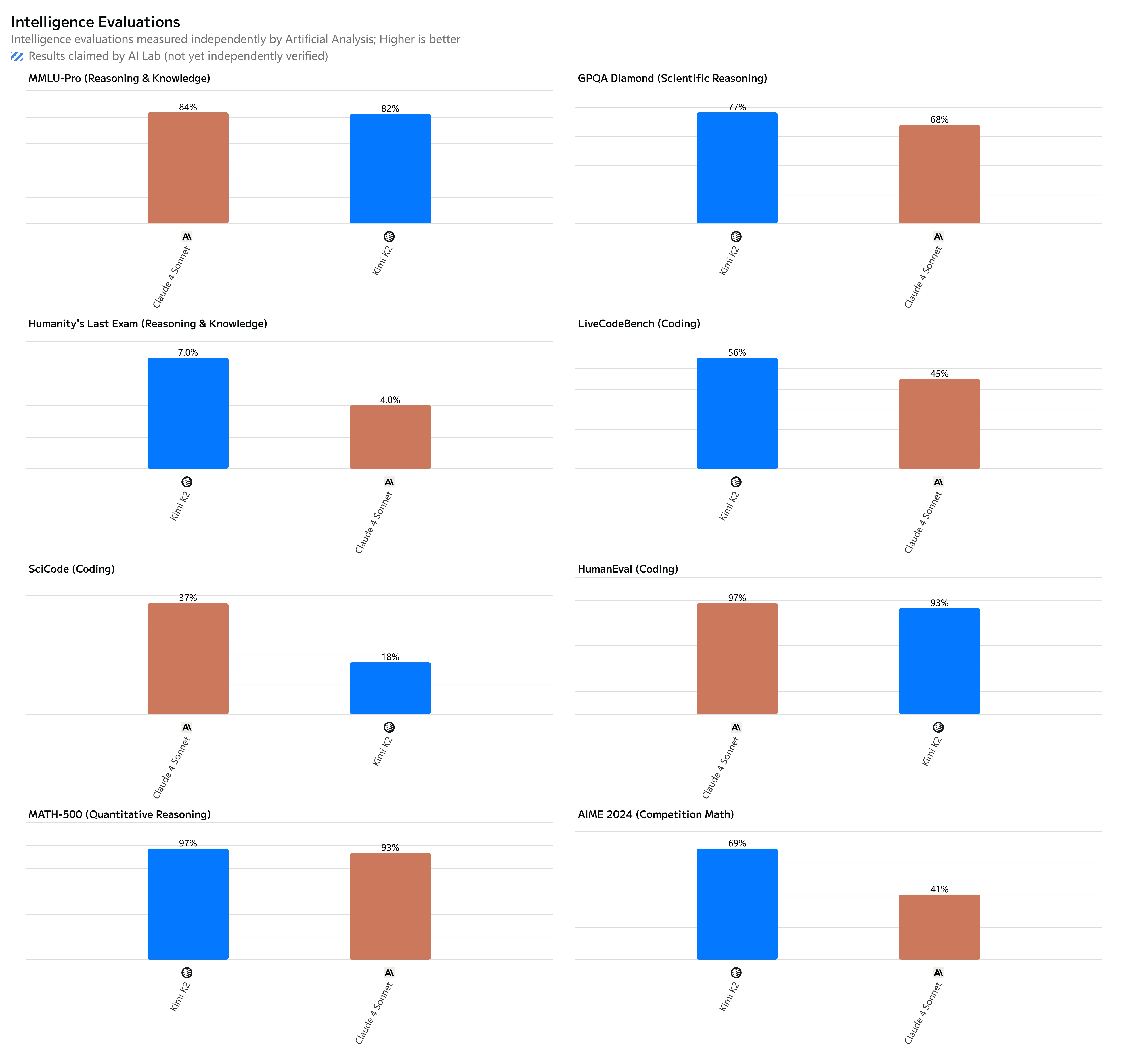
1. Intelligence & Reasoning Showdown
2. Context Window:
Claude 4 Sonnet: 200k Tokens
Kimi K2: 128k Tokens
3. API Pricing:
Kimi K2: $0.57 / $2.30 in/out per 1M Tokens
Claude 4 Sonnet: $3.00 / $15.00 in/out per 1M Tokens
Applied Skills Test
1. Creative Writing Challenge
Objective: To evaluate the nuance, style, and creativity of each model’s writing.
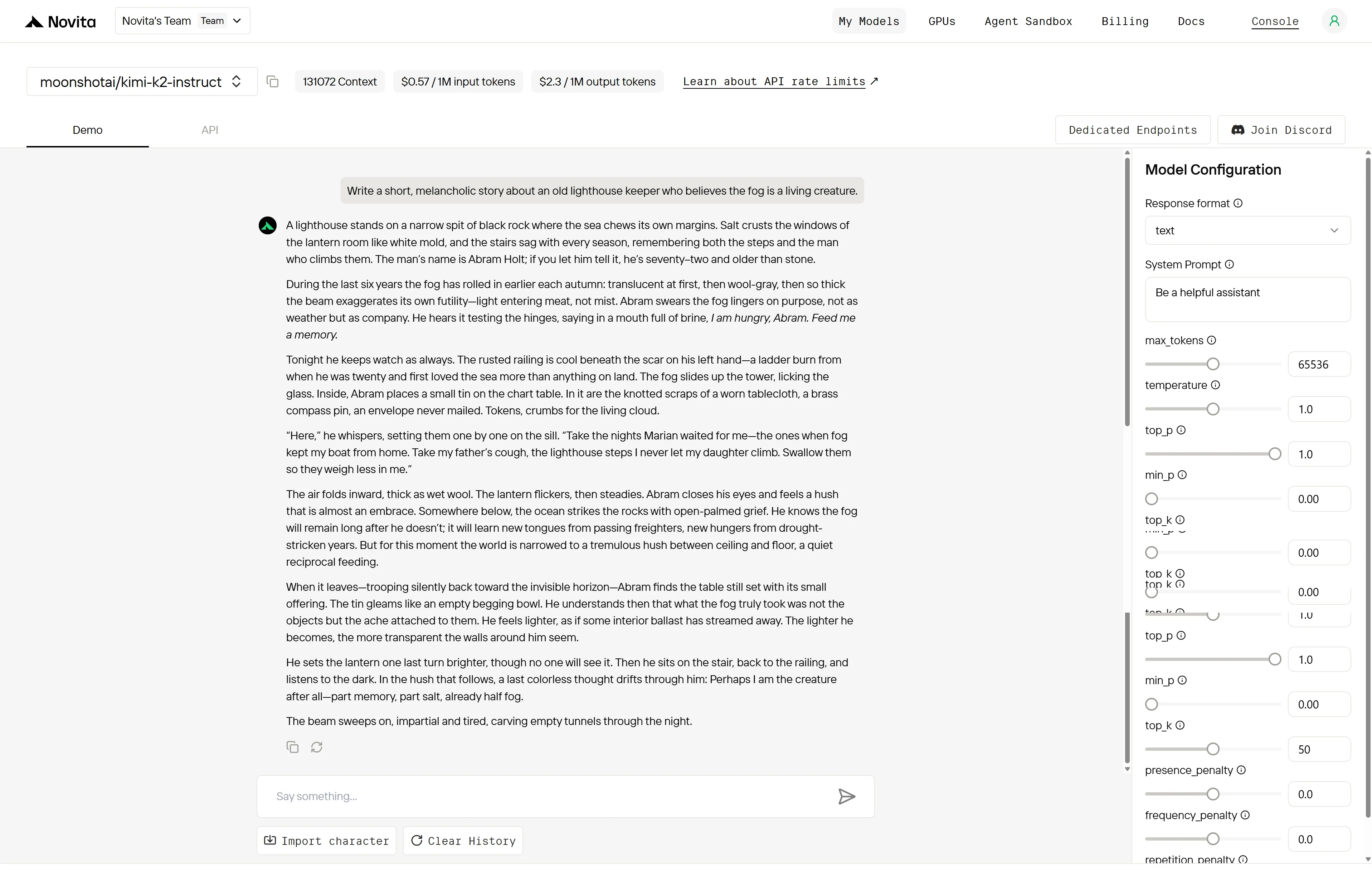
Sample Prompt: “Write a short, melancholic story about an old lighthouse keeper who believes the fog is a living creature.”
Evaluation Criteria:
- Originality: How unique and imaginative is the concept?
- Emotional Tone: Does it successfully capture the “melancholic” mood?
- Coherence: Is the narrative logical and easy to follow?
- Prose Quality: How well-written is the text in terms of style and vocabulary?
Kimi K2:
Claude 4 Sonnet:
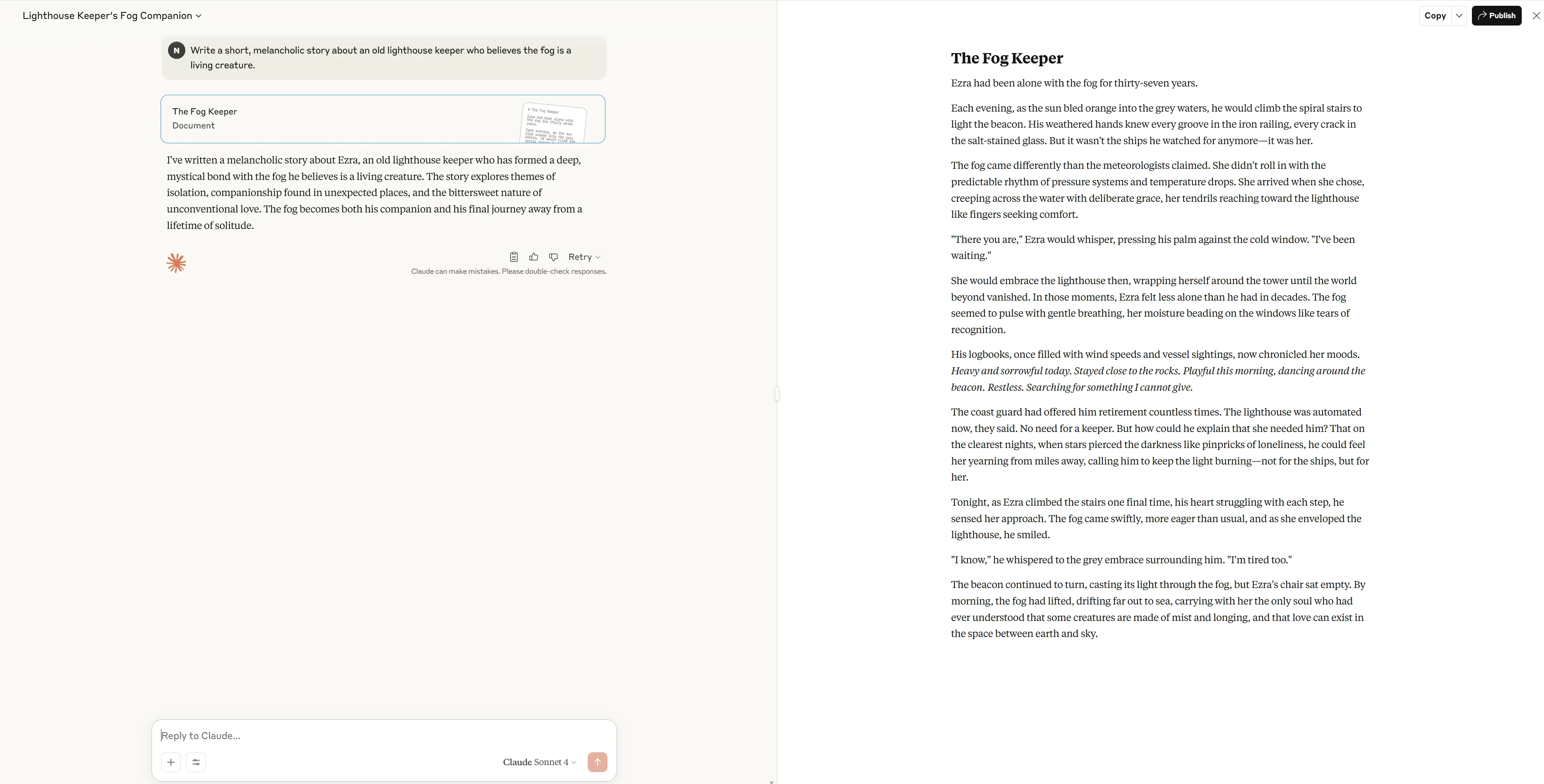
Kimi K2 produced a strikingly poetic, imaginative story with vivid metaphors and a strong, melancholic atmosphere. Its originality and prose quality stand out, making the reading experience both haunting and memorable. Claude 4 Sonnet provided a heartfelt, beautifully crafted narrative that excelled in emotional tone and clarity. While its language was a bit more conventional, the story’s emotional resonance and subtle personification of the fog were highly effective. Both models succeeded, but Kimi K2 demonstrated greater creativity and stylistic ambition, while Claude 4 Sonnet offered warmth and emotional depth in a more traditional narrative structure.
2. Coding Challenge
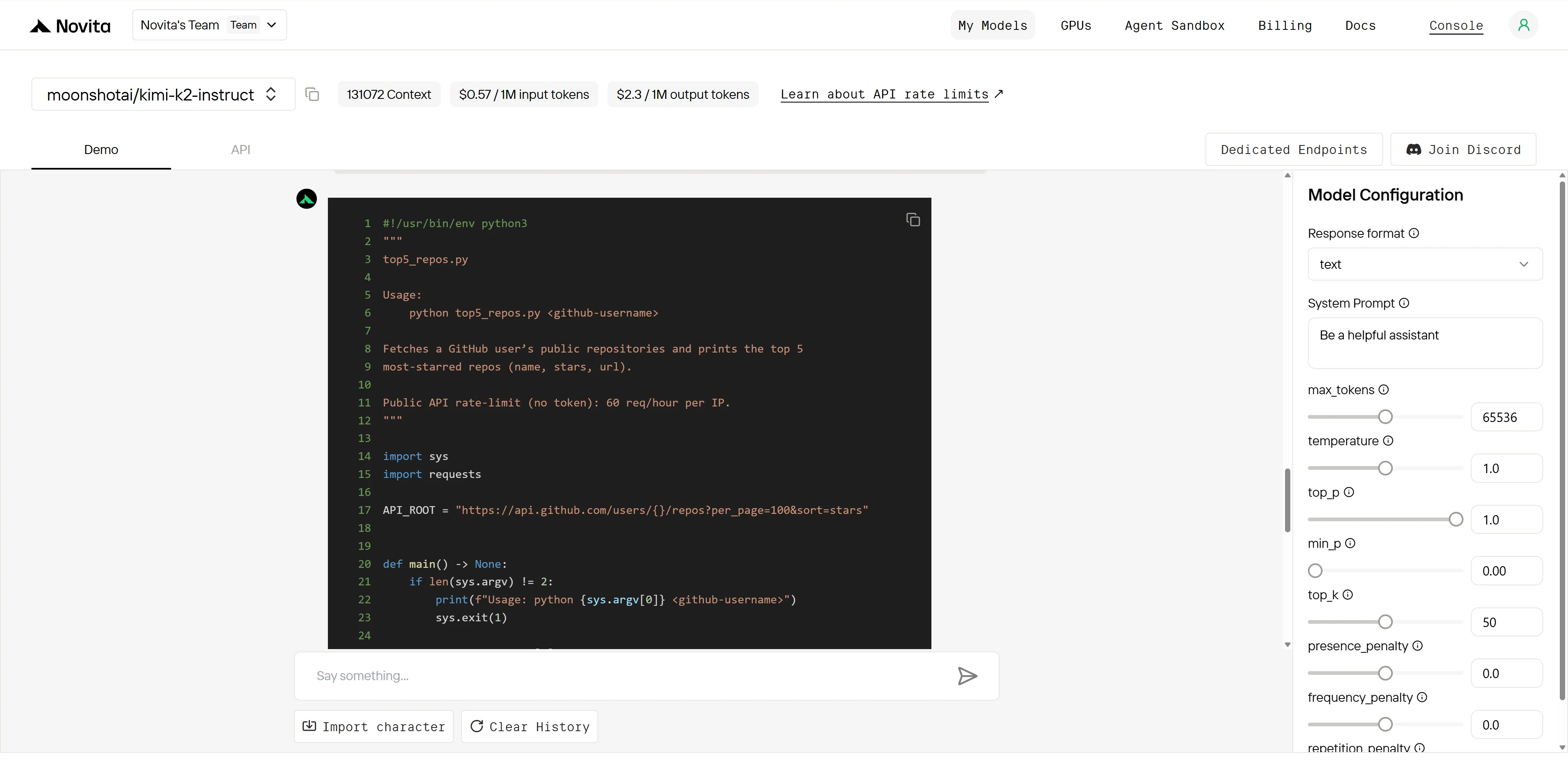
Objective: To test practical problem-solving and code generation beyond standardized benchmarks. Sample Task: “Write a Python script that scrapes the titles of the top 5 articles from the Hacker News homepage (news.ycombinator.com), handles potential network errors, and saves the titles to a file named ‘headlines.txt’.”
Evaluation Criteria:
- Functionality: Does the code run without errors and achieve the goal?
- Robustness: Does it include error handling (e.g., for a failed request)?
- Readability: Is the code clean, well-commented, and easy to understand?
- Efficiency: Does it use appropriate libraries and methods?
Kimi K2:
Claude 4 Sonnet:
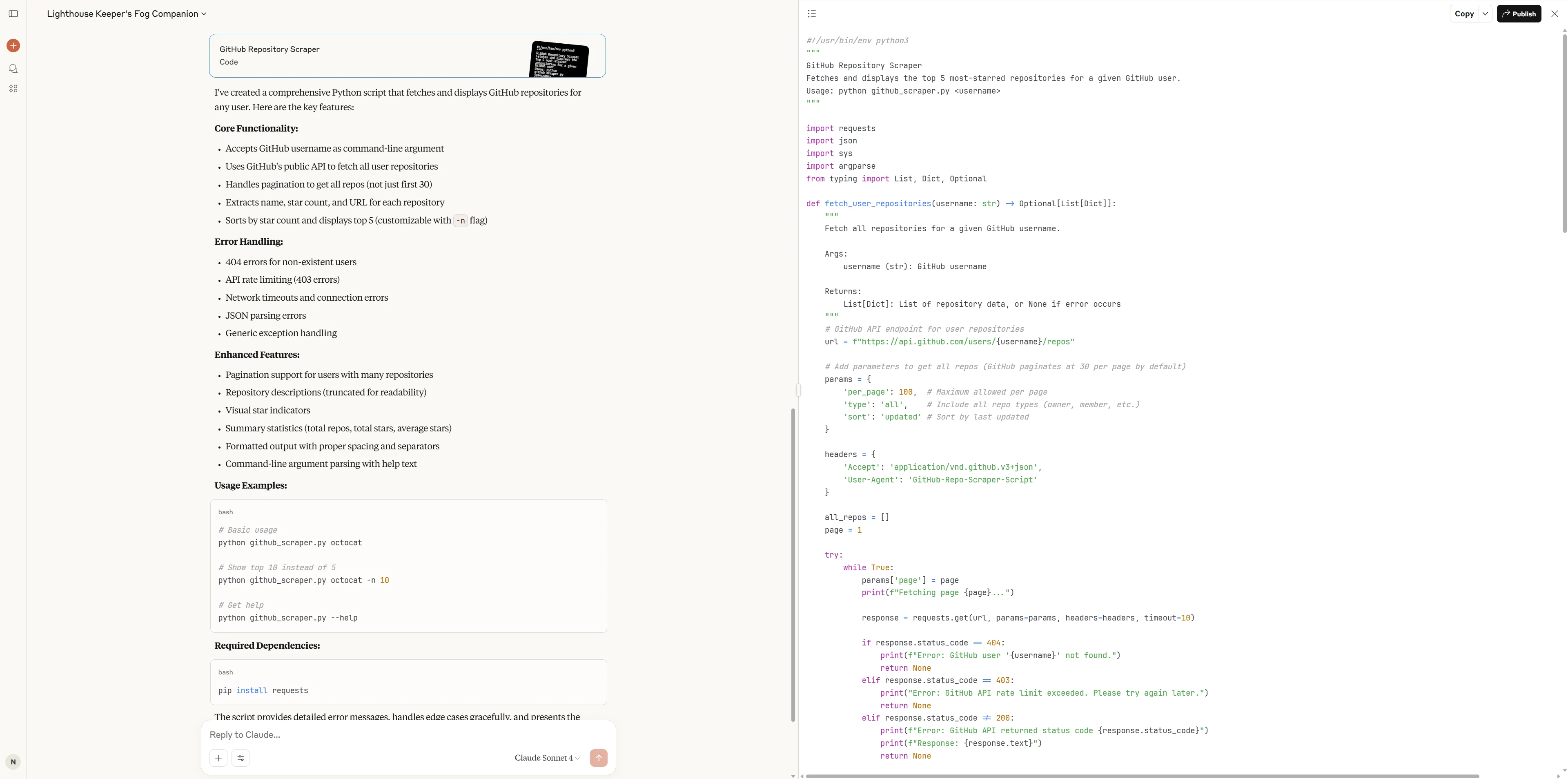
Kimi K2 produces a compact, effective, and robust solution suitable for most practical needs, prioritizing simplicity and efficiency. Claude Sonnet 4 delivers a more feature-rich, modular, and professional-grade script with superior error handling and user experience, ideal for more demanding or production-like environments. Both fulfill all core requirements, with Kimi K2 excelling in minimalism and Claude Sonnet 4 in extensibility and polish.
Strengths & Weaknesses
Kimi K2
- Strengths:
- Elite Reasoning Power: Superior performance in complex math and science problems.
- Overwhelming Cost Advantage: Extremely low API prices make it highly economical.
- Weaknesses:
- Smaller Context Window: Its 128k token limit restricts the maximum size of a single input.
- Slightly Weaker General Knowledge: Marginally lower score in the MMLU-Pro benchmark.
Claude 4 Sonnet
- Strengths:
- Leading Versatility & Capacity: Its 200k token window enables broad use cases for long-document analysis.
- Solid Generalist Abilities: Strong and stable performance on general knowledge and key coding benchmarks.
- Weaknesses:
- Prohibitive Cost: API prices are several times higher than Kimi K2’s, posing a budget challenge.
- Weaker Advanced Reasoning Power: Significantly lags behind Kimi K2 in high-difficulty reasoning tasks.
How to Access Kimi K2 on Novita AI
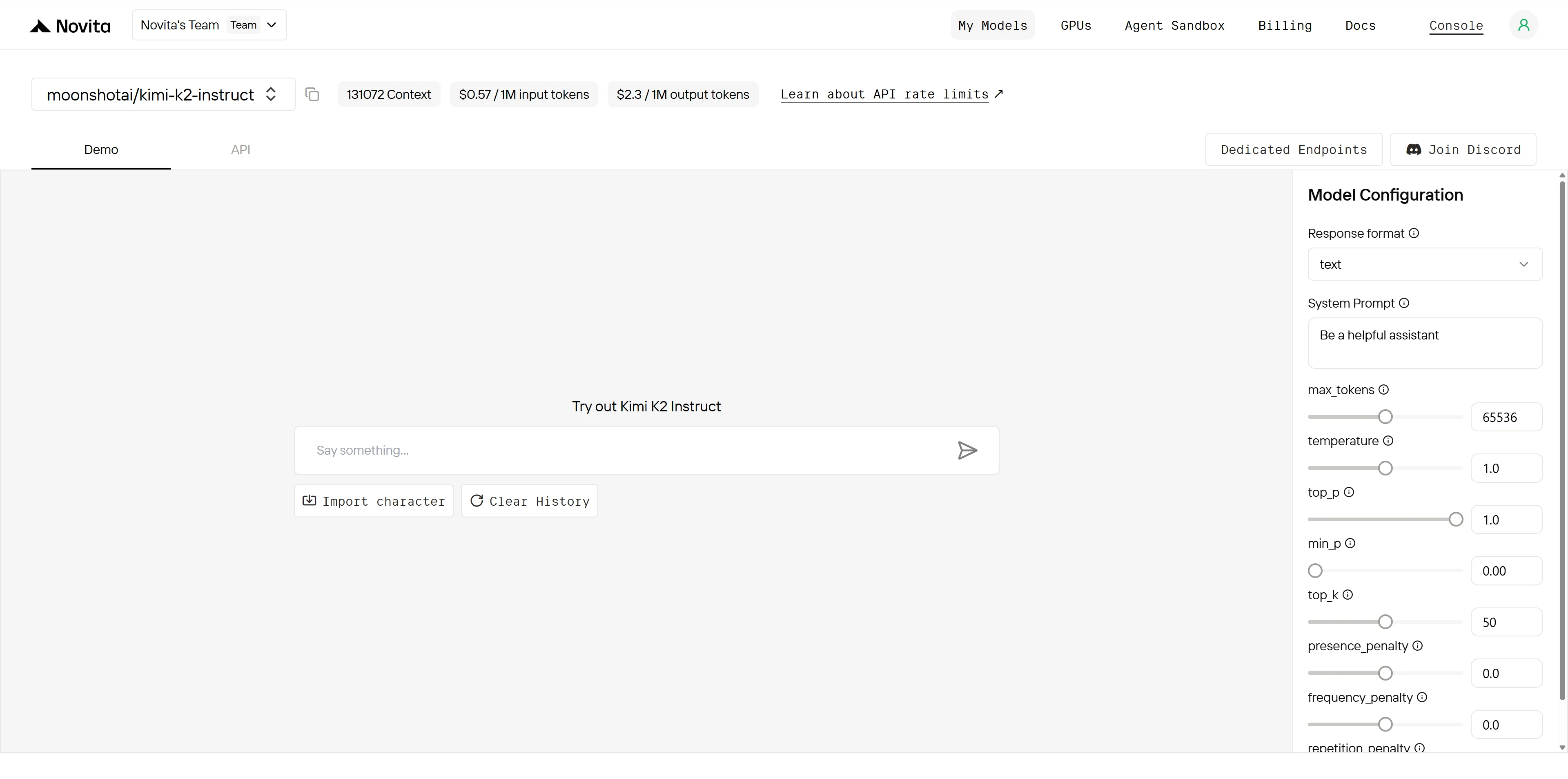
1. Use the Playground (No Coding Required)
- Instant Access: Sign up, claim your free credits, and start experimenting with Kimi K2 and other top models in seconds.
- Interactive UI: Test prompts, chain-of-thought reasoning, and visualize results in real time.
- Model Comparison: Effortlessly switch between Qwen 3, Llama 4, DeepSeek, and more to find the perfect fit for your needs.
2. Integrate via API (For Developers)
Seamlessly connect Kimi K2 to your applications, workflows, or chatbots with Novita AI’s unified REST API—no need to manage model weights or infrastructure.
Direct API Integration (Python Example)
To get started, simply use the code snippet below:
from openai import OpenAI

client = OpenAI(
    base_url="https://api.novita.ai/v3/openai",
    api_key="<YOUR Novita AI API Key>",
)

model = "moonshotai/kimi-k2-instruct"
stream = True # or False
max_tokens = 2048
system_content = ""Be a helpful assistant""
temperature = 1
top_p = 1
min_p = 0
top_k = 50
presence_penalty = 0
frequency_penalty = 0
repetition_penalty = 1
response_format = { "type": "text" }

chat_completion_res = client.chat.completions.create(
    model=model,
    messages=[
        {
            "role": "system",
            "content": system_content,
        },
        {
            "role": "user",
            "content": "Hi there!",
        }
    ],
    stream=stream,
    max_tokens=max_tokens,
    temperature=temperature,
    top_p=top_p,
    presence_penalty=presence_penalty,
    frequency_penalty=frequency_penalty,
    response_format=response_format,
    extra_body={
      "top_k": top_k,
      "repetition_penalty": repetition_penalty,
      "min_p": min_p
    }
  )

if stream:
    for chunk in chat_completion_res:
        print(chunk.choices[0].delta.content or "", end="")
else:
    print(chat_completion_res.choices[0].message.content)
By integrating Kimi-K2 through Novita AI’s platform, you can easily set up Kimi-K2 alongside Claude Code on both Windows and Mac. Click to learn how!
Kimi K2 and Claude 4 Sonnet serve distinct but complementary use cases.
If your priority is elite reasoning in math and science, automation via function calling, or maximum cost-efficiency, Kimi K2 is the clear choice. However, if you need to analyze massive documents with its 200k context window or require a capable generalist for a wide range of tasks, Claude 4 Sonnet stands out as the more versatile choice.
Frequently Asked Questions
What is Kimi K2?
Kimi K2 is a highly cost-effective AI model from Moonshot AI that specializes in advanced reasoning for tasks like math and coding and supports function calling. Its combination of high performance and low price makes it ideal for demanding, budget-sensitive applications.
What is the difference between Claude and Sonnet?
“Claude” is the name of the AI model family from Anthropic, while “Sonnet” is a specific model within that family. Sonnet is designed to offer a balanced blend of performance, speed, and cost.
Is Claude Opus better than Sonnet?
While Claude Opus is generally the most powerful model, Sonnet is faster, significantly more cost-effective, and even outperforms Opus on certain benchmarks, making it better for many business applications
Novita AI is an AI cloud platform that offers developers an easy way to deploy AI models using our simple API, while also providing the affordable and reliable GPU cloud for building and scaling.