In late 2025, the frontier model landscape shifted toward “Hybrid Reasoning”—models that pause to “think” before generating a response. Two major flagship models define this era: Anthropic’s Claude 4.5 Sonnet and Z.AI’s GLM-4.7. While Claude focuses on proprietary, agentic excellence with native computer control, GLM-4.7 offers a powerful open-weights alternative with unique cost efficiencies and state-of-the-art mathematical capabilities.
GLM-4.7 vs Claude 4.5 Sonnet: Basic Introduction
Both models integrate “Chain of Thought” (CoT) reasoning directly into the generation process, but they approach architecture and deployment differently.
| Feature | GLM-4.7 | Claude 4.5 Sonnet |
| Developer | Z.AI (Open Weights) | Anthropic (Closed Source) |
| Release Date | Dec 22, 2025 | Sep 29, 2025 |
| Architecture | 358B Parameter Mixture-of-Experts (MoE) | Proprietary Hybrid Reasoning Model |
| Context Window | 200k Input / 128k Output | 200k Input / 64k Output |
GLM-4.7 vs Claude 4.5 Sonnet: Benchmark
Math / Olympiad-style Reasoning
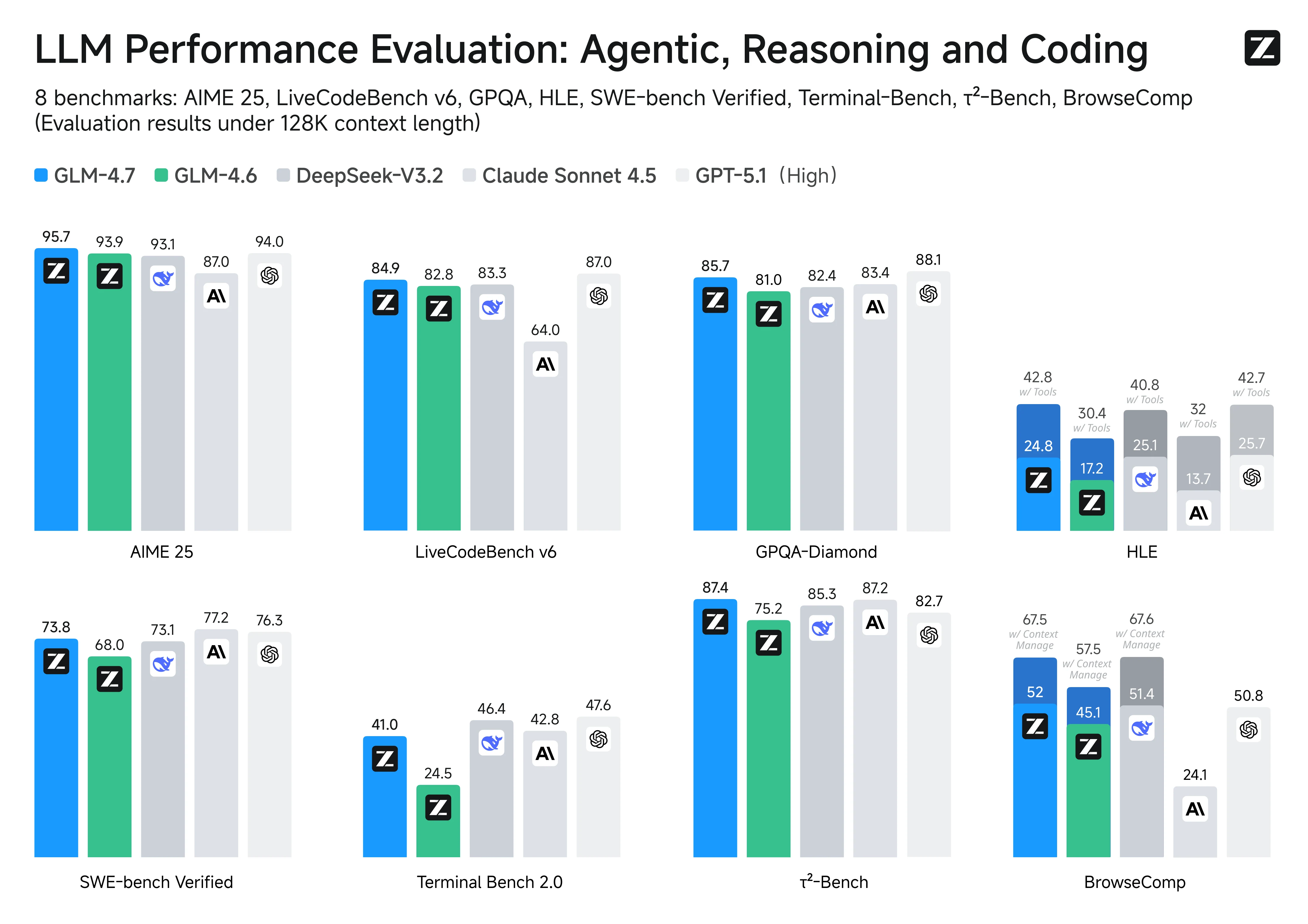
- AIME 2025: GLM-4.7 95.7 vs Claude 87.0 (+8.7 for GLM)
Coding (benchmark-style)
- LiveCodeBench-v6: GLM-4.7 84.9 vs Claude 64.0 (+20.9 for GLM)
Real-world Software Engineering
- SWE-bench Verified: GLM-4.7 73.8 vs Claude 77.2 (+3.4 for Claude)
Agentic Terminal Tasks
- Terminal Bench 2.0: GLM-4.7 41.0 vs Claude 42.8 (+1.8 for Claude; very close)
Tool Use / Interactive Tool Invocation
- τ²-Bench: GLM-4.7 87.4 vs Claude 87.2 (essentially tied)
- HLE (w/ Tools): GLM-4.7 42.8 vs Claude 32.0 (+10.8 for GLM)
Web Task / Browsing-style Evaluation
- BrowseComp: GLM-4.7 52.0 vs Claude 24.1 (+27.9 for GLM)
- BrowseComp (w/ Context Manage): GLM-4.7 67.5 (Claude not reported in that row on the same table)
💡Interpretation:
- If your priority is math reasoning and benchmark-style coding, GLM-4.7 leads strongly (AIME, LiveCodeBench).
- If your priority is real software engineering, Claude leads on SWE-bench Verified.
- For interactive tool use, the picture is mixed: τ²-Bench is a tie, but GLM-4.7 is higher on tool-augmented HLE and BrowseComp in the published table.
GLM-4.7 vs Claude 4.5 Sonnet: Speed & Latency
🤖Net takeaway:
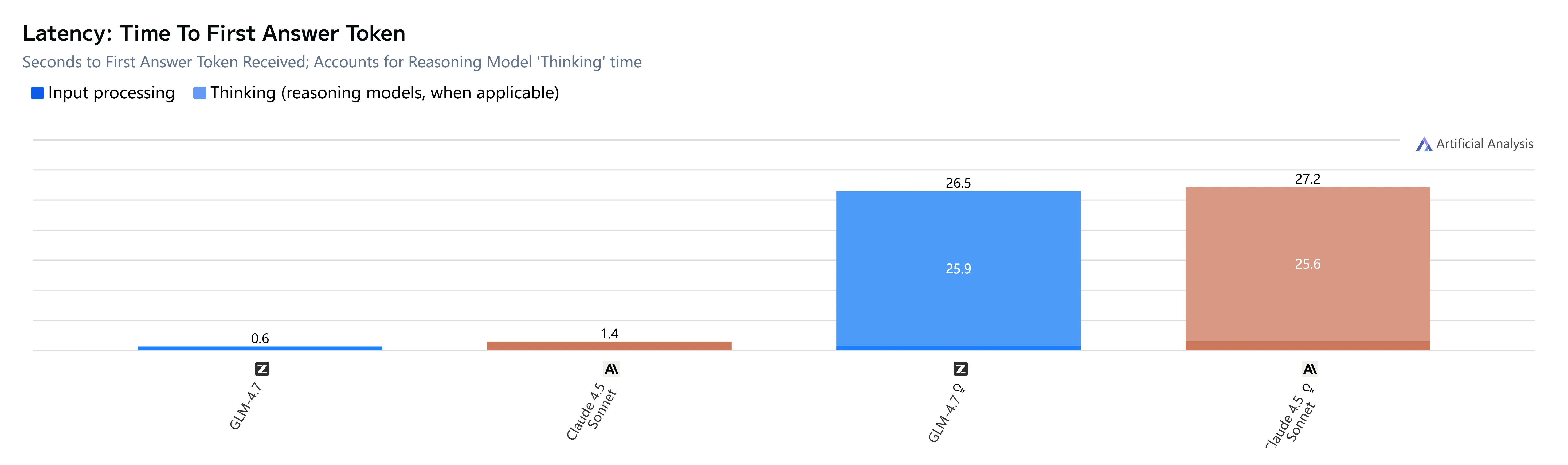
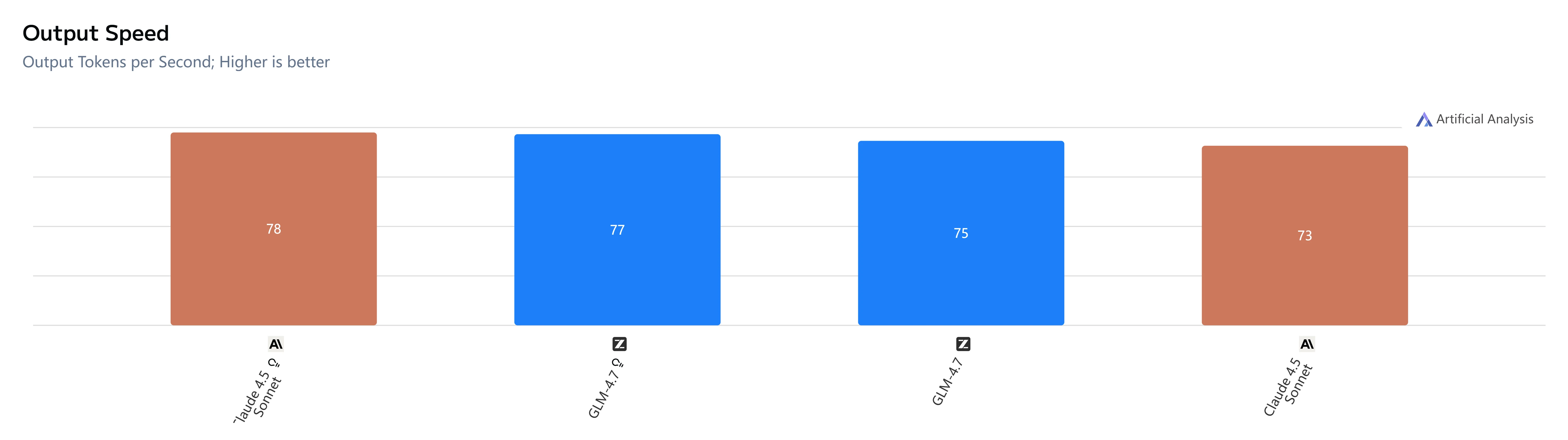
GLM-4.7 has a small edge in “snappy” responses, while in deep-reasoning scenarios both behave similarly—so optimizing perceived speed is mostly about controlling when the model enters long thinking rather than choosing between the two on decode speed alone.
GLM-4.7 vs Claude 4.5 Sonnet: Cost
GLM-4.7 offers a significant cost advantage. The following table compares Novita AI’s pricing for GLM-4.7 against Anthropic’s direct API pricing.
| Model | Provider | Input Price (per 1M tokens) | Output Price (per 1M tokens) |
| GLM-4.7 | Novita AI | $0.60 | $2.20 |
| Claude 4.5 Sonnet | Anthropic | $3.00 | $15.00 |
🎉Cost Implication:
GLM-4.7 is 5x cheaper on input and roughly 6.8x cheaper on output than Claude 4.5 Sonnet. For applications requiring heavy reasoning (which generates more output tokens), GLM-4.7 provides a massive reduction in operational expenditure.
How to Access GLM 4.7 on Novita Al
Novita AI provides flexible and developer-friendly access to GLM-4.7, enabling you to use this high-performance hybrid-reasoning model across research, production, and agentic AI workflows. Whether you are exploring advanced mathematics, large-scale code generation, or building cost-efficient autonomous systems, Novita AI offers the infrastructure to get started quickly.
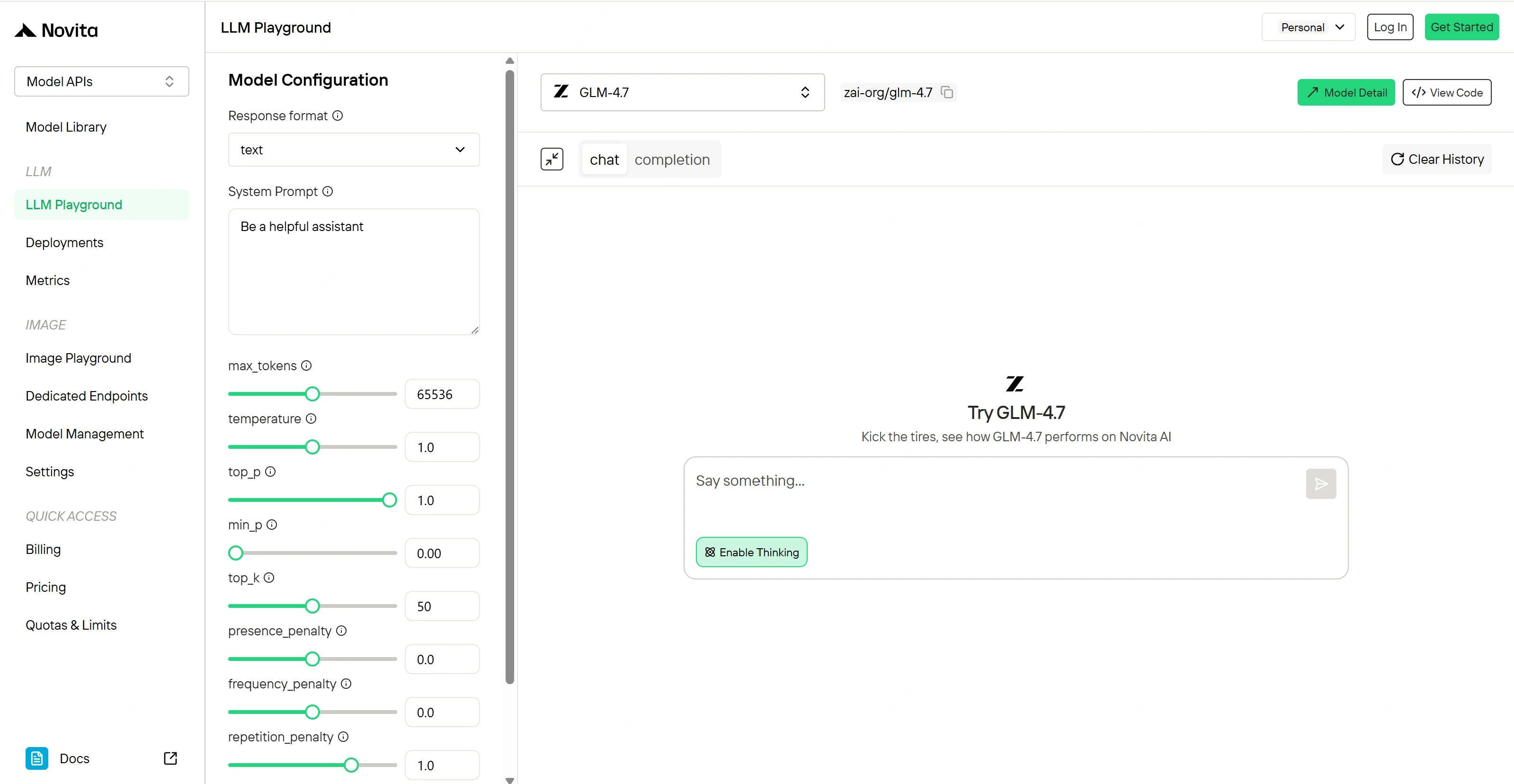
Option 1: Use the Playground
(Available Now – No Coding Required)
- Instant Access: Create an account and start experimenting with GLM-4.7 in seconds.
- Interactive Interface: Test prompts, toggle reasoning behavior, and inspect long-context outputs in real time.
- Model Comparison: Compare GLM-4.7 with other flagship models to evaluate reasoning depth, cost efficiency, and output quality.
The Playground is ideal for prototyping, prompt experimentation, and evaluating GLM-4.7’s strengths in mathematics, tool use, and high-aesthetic code generation before integrating it into production systems.
Option 2: Integrate via API
(For Developers)
Bring GLM-4.7 into your applications using Novita AI’s OpenAI-compatible unified API.
Step 1: Log In and Access the Model Library
Log in (or sign up) to your Novita AI account and navigate to the Model Library.
Step 2: Choose GLM-4.7
Browse the available models and select GLM-4.7 based on your workload requirements.
Step 3: Start Your Free Trial
Activate your free trial to explore GLM-4.7’s reasoning, long-context, and cost-performance characteristics.
Step 4: Get Your API Key
Open the Settings page to generate and copy your API key for authentication.
Step 5: Install and Call the API (Python Example)
Below is a simple example using the Chat Completions API with Python:
from openai import OpenAI

client = OpenAI(
    api_key="<Your API Key>",
    base_url="https://api.novita.ai/openai"
)

response = client.chat.completions.create(
    model="zai-org/glm-4.7",
    messages=[
        {"role": "system", "content": "You are a helpful assistant."},
        {"role": "user", "content": "Hello, how are you?"}
    ],
    max_tokens=131072,
    temperature=0.7
)

print(response.choices[0].message.content)
This setup allows you to control reasoning depth, token usage, and generation behavior—particularly useful when leveraging turn-level thinking to manage cost and latency.
Option 3: Multi-Agent Workflows with OpenAI Agents SDK
Build sophisticated multi-agent systems using GLM-4.7 as a reasoning or tool-specialist agent:
- Plug-and-Play Integration: Use GLM-4.7 in any OpenAI Agents workflow.
- Advanced Agent Patterns: Support for routing, handoffs, tool invocation, and mixed “Think / Non-Think” modes.
- Cost-Efficient Scaling: Ideal for large agent swarms or math-heavy reasoning tasks at scale.
This approach is well suited for combining GLM-4.7 with other models—for example, using GLM-4.7 for mathematical reasoning and structured coding, while delegating OS-level tasks to other agents.
Option 4: Connect with Third-Party Platforms
- Development Tools: Integrate GLM-4.7 with IDEs and AI coding tools such as Cursor, Trae, Qwen Code, and Cline via Novita AI’s OpenAI-compatible API.
- Orchestration Frameworks: Connect GLM-4.7 to LangChain, Dify, CrewAI, Langflow, and other orchestration platforms using official connectors.
- Hugging Face Ecosystem: Novita AI acts as an official inference provider for Hugging Face, ensuring broad compatibility across the open-source ML ecosystem.
Conclusion
Claude Sonnet 4.5 is the stronger choice when you prioritize real-world software engineering outcomes (e.g., SWE-bench Verified lead) and when your product depends on computer interaction capabilities supported through Anthropic’s Computer Use tooling.
GLM-4.7 is compelling when you want an open-weights model with strong published results on math reasoning, benchmark-style coding, and several tool/browsing-style evaluations, while offering a large pricing advantage under Novita’s rates.
Frequently Asked Questions
Is GLM better than Sonnet?
GLM-4.7 is better for cost, math, and local deployment, while Claude 4.5 Sonnet is better for reliability, computer use, and enterprise safety.
Pick GLM-4.7 if you optimize for cheap, large-scale coding, advanced math, or need to self-host.
Pick Sonnet if you need the most dependable coding agent, strong computer-use tools, and strict safety/compliance.
What is GLM 4.7?
GLM-4.7 is Z.ai’s flagship LLM, positioned for enhanced programming and more stable multi-step reasoning/execution, and it is released with an official open-weights model (available on Hugging Face).
What is Claude Sonnet 4.5?
Claude Sonnet 4.5 is Anthropic’s general-purpose flagship in the Claude family, marketed for daily production use and complex tasks, and available via the Claude API as claude-sonnet-4-5 with pricing starting at $3/M input + $15/M output
Novita AI is an AI cloud platform that offers developers an easy way to deploy AI models using our simple API, while also providing the affordable and reliable GPU cloud for building and scaling.