Finding the optimal model for your specific application and getting it into production is difficult. Unlike closed-source options from OpenAI or Claude, open models are rarely hosted. You’re often left to configure compute, latency, and throughput requirements on your own. This complexity leads many developers and companies to default to familiar general-purpose models like GPT-4 or Claude, even when open alternatives, including both lightweight specialists and powerful generalists, could offer better performance, faster responses, and lower costs. This is where Novita comes into the picture. Novita hosts open-source models, and if necessary, configures it to your specific requirements, so you can use these models without the hassle.
Why Does Everyone Use GPT-4?
The AI model landscape is growing rapidly, comprising hundreds of models, each with their unique strengths and weaknesses. However, despite the rising performance of open-source models, the GPT-4x series, the Claude 3x series, and other closed models remain the default choice for many teams. In this piece, we’ll break down when it makes sense to use closed models, when it doesn’t, and how Novita makes deploying open-source LLMs as easy as using one of the closed-source ones.
These popular closed-source models are hosted and easy to use, so there’s no need to worry about infrastructure, setup, or deployment. You just call an API and get inference. These models are also broadly capable, performing well across a range of general-purpose tasks like writing, reasoning, and coding. And since they’re widely adopted, they’re perceived as a low-risk option.
… But at What Cost?
Defaulting to closed, general-purpose models may feel like the safest choice, but it often leads to hidden costs. Relying solely on closed models can lock you out of powerful open-source alternatives like Qwen and DeepSeek, which deliver comparable or better results with greater control, transparency, and long-term cost efficiency. In fact, many teams end up overpaying for scale and features they don’t actually use, wasting compute and energy on tasks that don’t require massive 100B+ parameter models with environmental consequences to match. Additionally, general performance can suffer on niche tasks where smaller and/or more specialized models excel.
Many open models now match or outperform top-tier closed models across key tasks:
- Kimi K2, DeepSeek R1, and Qwen 3 235B A22B outperform the GPT-4x series on coding and mathematical reasoning tasks at a fraction of the cost (Source: Huggingface, GeeksforGeeks, Artificial Analysis)
- Qwen 2.5 7B Instruct outperforms GPT-4 on the GPQA, HumanEval, and MATH benchmarkswhile using only a fraction of the resources (Source: LLM Stats)
- Qwen3-Coder-480B-A35B-Instruct is comparable to Claude 4 Sonnet (Source: Huggingface, Venture Beat)
- DeepSeek V3 supports more underrepresented languages than GPT-4o (Source: Machine Translation )
- Llama 3.1 outperforms GPT-4 and Claude 3.5 Sonnet in math and long context (Source: OpenAI Developer Community )
These results highlight a growing reality: if you know your task and constraints, you can often get better outcomes at a lower cost with open models.
Using GPT-4 by default rather than alignment with your needs has its consequences:
- Products relying on specialized reasoning settle for passable outputs from generalist models, when more specialized (and often, smaller) models can offer better performance
- Using a large model when a smaller one can do the trick increases energy use and has significant negative environmental impact
- Startups and smaller teams often burn their budget on expensive APIs when open-source models can easily deliver the same (or better) results
- Enterprises at scale rack up huge costs across high-volume inference, unaware that open alternatives can cut those bills by half or more
The Case for Using Open Source Models
Models like the GPT-4x and the Claude 3 series are powerful generalists and broadly capable across a wide range of tasks, from coding to creative writing. But their horizontal capability often means they’re not the most efficient or affordable choice for targeted workloads or constrained environments. Many open-source models, including both compact specialists and large, general-purpose alternatives, can match or outperform them, offering better speed, control, and cost efficiency.
But finding the optimal model for your specific application and getting it into production is difficult. Unlike closed-source options from OpenAI or Claude, open models are rarely hosted. You’re often left to configure compute, latency, and throughput requirements on your own. This complexity leads many developers and companies to default to familiar general-purpose models like GPT-4 or Claude, even when open alternatives, including both lightweight specialists and powerful generalists, could offer better performance, faster responses, and lower costs. This is where Novita comes into the picture. Novita hosts open-source models, and if necessary, configures it to your specific requirements, so you can use these models without the hassle.
Moonshot AI’s Kimi K2 is a standout example of an open-source LLM that outperforms GPT-4.1. In coding and mathematical reasoning, Kimi-K2 achieves 53.7% accuracy, compared to GPT-4.1’s 44.7% (Source: Huggingface).
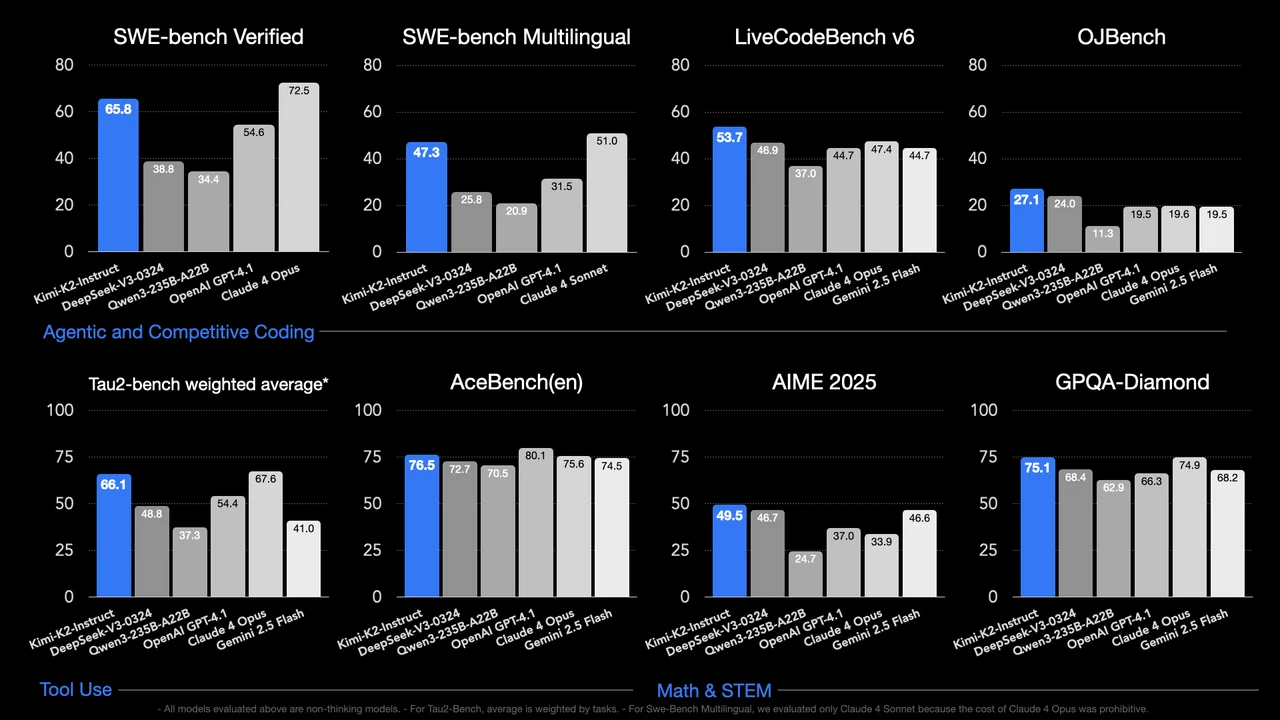
Title: Kimi K2’s Performance vs GPT-4.1 and Other Industry Leaders
Source: Huggingface
When Generalist Models Make Sense
Closed models like GPT-4, Claude, and Gemini still have their place, especially in situations where you’re prototyping quickly and want a strong general performance benchmark. They’re also a good fit when your workloads span a wide range of tasks without a clear specialization, or when you’re running low-volume inference and cost isn’t yet a major concern. In these cases, the convenience, broad capability, and out-of-the-box performance of generalist models can outweigh the tradeoffs.
As usage grows, it’s worth finding the right model for your application. This model should be optimized for your specific tasks, constraints, and scale, rather than what’s popular or convenient. That brings us to the next question: How do you choose the right model for your application?
How to Choose the Right Model for Your Application
Choosing the best model isn’t just about benchmark performance on a narrow task. It’s an optimization problem, requiring you to balance tradeoffs between specialization, latency, throughput, and cost.
Here are the key dimensions to consider:
- Use case specificity: Do you need a generalist assistant or an expert on tasks like summarization or logical reasoning? Specialized use cases often benefit from smaller models fine-tuned for the job, while generalist models offer broader coverage but at higher cost and latency.
- Performance vs. Latency: How fast does your application need to respond? A chatbot would favor more lightweight or low-latency models like DeepSeek-V3, which offer near-instant responses with strong task-specific performance. Slower models may jeopardize user experience, even if they’re more powerful on paper.
- Cost vs. Scale: What are your expected usage volumes? A model that costs fractions of a cent per request might seem negligible early on. When running at scale, however, those costs add up. Open-source models running on your own infrastructure (or with a hosted platform like Novita) can reduce cost dramatically at scale.
- Flexibility and control: Do you need to adapt the model to your domain, tone, or task structure? Open models give you options to fine-tune and optimize the model around your needs instead of working around someone else’s. For this case, Novita offers model hosting support for your custom or fine-tuned models.
- Infrastructure tradeoffs: What infrastructure do you have or want to avoid managing? If you want to avoid spinning up GPUs or managing infrastructure, it’s easy to assume closed models like GPT-4 are your only option. However, platforms like Novita offer the same seamless, fully hosted experience for open models at down to 50% of the cost.
It’s not about abstractly picking the “best model”. In practice, you’re optimizing across competing constraints, such as task fit, latency, and cost. The right model depends on your goals, and a good platform makes it easy to test, swap, and iterate until you find the optimal fit. Resources like Artificial Analysis help disambiguate these tradeoffs and can help you make informed decisions.
Beyond One-Size-Fits All
The dominance of models like GPT-4 doesn’t necessarily mean they’re better; just that they’re convenient. But that tradeoff is no longer necessary. Platforms like Novita AI are closing the gap between open weights and production readiness, giving developers access to hundreds of open models without the hassle of infrastructure. So don’t reach for GPT-4 by default. Your model should fit your application, not the other way around.
At Novita AI, our experts provide hands-on support, including custom model recommendations and infrastructure tuning. We’ll help you configure the right open-source model for your specific use case based on critical dimensions like specialization, latency, throughput, and cost efficiency. We provide the speed, reliability, and ease you expect from top-tier APIs with the flexibility and cost advantages of open-source models. Contact us for more information.