DeepSeek V3.1 and Claude 4 stand out as two of the most powerful AI models available today. Both bring unique design choices and capabilities, reflecting different approaches to scaling reasoning, coding, and language tasks.
In this article, we’ll explore their strengths, differences, and practical use cases to help you decide which model better fits your needs.
Start Your Free Trial of DeepSeek V3.1 !
DeepSeek V3.1 vs Claude 4: Basic Introduction
| Feature | DeepSeek V3.1 | Claude 4 Opus | Claude 4 Sonnet |
| Model Size | 671B in total, 37B activated | Not released | Not released |
| Architecture | Transformer-based | Not released | Not released |
| Open Source | Yes | No | No |
| Context Length | 128K | 200K | 200K |
| Thinking Mode | Hybrid (Think + Non-Think) | Hybrid (Near-Instant Responses + Extended Thinking) | Hybrid (Near-Instant Responses + Extended Thinking) |
| Image Input Support | Yes | Yes | Yes |
| Language Support | Excels in Chinese and English, support for over 100 languages | Robust multilingual zero‑shot, benchmarked high accuracy | Optimized for English, with strong multilingual support |
DeepSeek V3.1 vs Claude 4: Benchmark
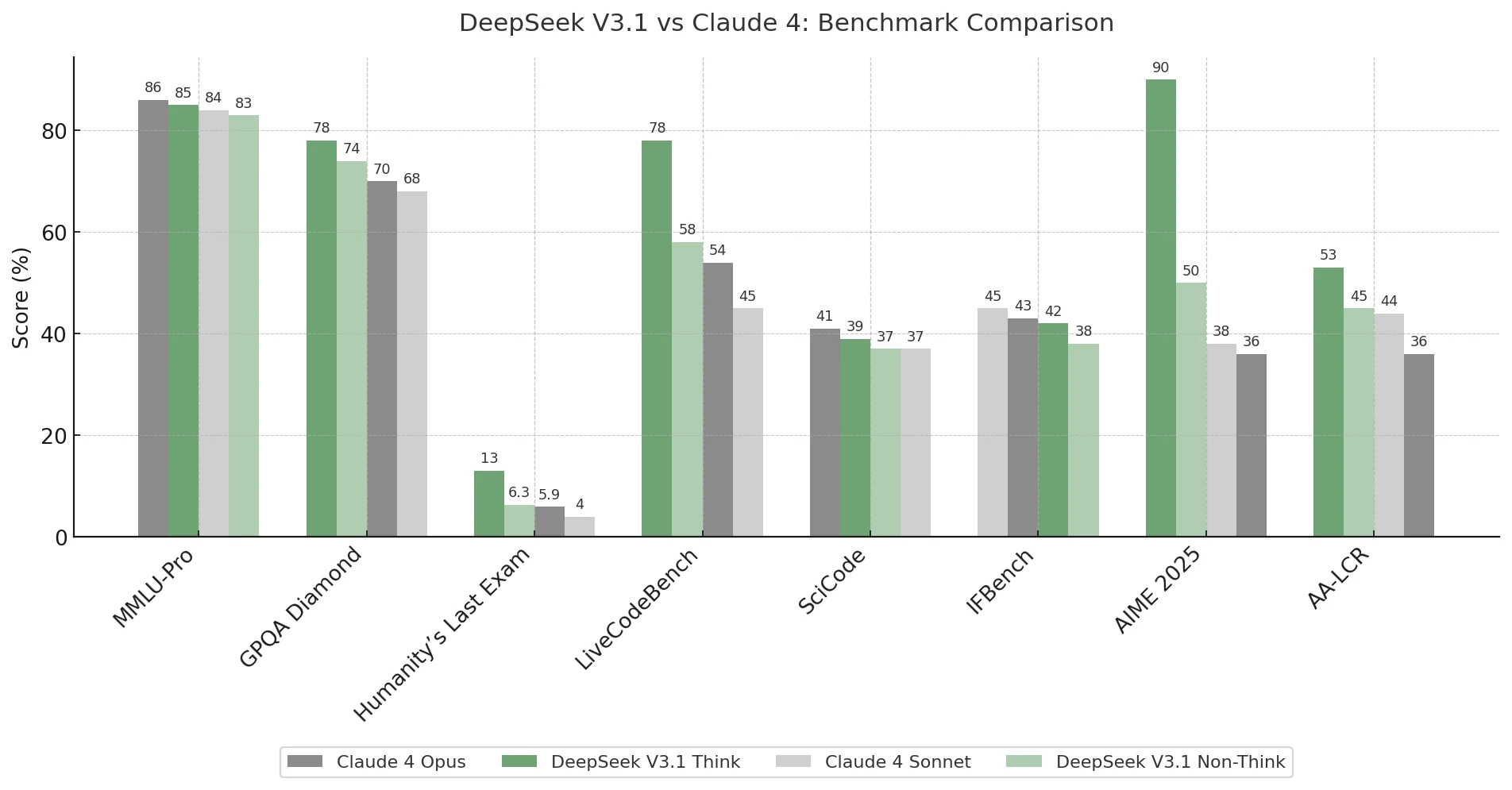
General Knowledge & Instruction Adherence
- Claude 4 shows slightly stronger consistency across disciplines and produces smooth, interactive responses that fit well into workflows like customer support, content creation, and knowledge management.
- DeepSeek V3.1 is close behind in overall reliability, and given its efficiency and pricing advantage, it provides a highly competitive option for organizations that value balanced performance with lower costs.
Coding Capabilities
- Claude 4 performs well on structured, exam-style programming challenges, delivering stable results on algorithmic or data-processing tasks where the problem is clearly defined. This makes it a dependable tool for educational, engineering, and technical documentation use cases.
- DeepSeek V3.1 distinguishes itself in agentic coding scenarios, where the model must generate executable code that integrates into broader systems or iterate toward runnable solutions. This makes it especially valuable for developer productivity, automated testing, and prototyping.
Advanced Reasoning
- Claude 4 remains a solid performer on reasoning-heavy tasks, but its strength lies more in practical day-to-day reasoning rather than extreme problem solving.
- DeepSeek V3.1 in Think mode takes the lead when multi-step logical construction, scientific inference, or cross-domain analysis is required. It sustains deeper reasoning chains, which makes it a stronger choice for research, diagnostics, and strategy-oriented applications.
Mathematical Problem-Solving
- Claude 4 handles everyday numerical reasoning reliably, supporting business operations, analytics, and routine quantitative tasks.
- DeepSeek V3.1 excels on advanced mathematical challenges, including symbolic reasoning and competition-level problem solving, which positions it as the superior model for quantitative finance, advanced data science, and technically rigorous domains.
Takeaway
- Claude 4 is best suited for teams prioritizing smooth interaction, reliable knowledge grounding, and strong instruction following.
- DeepSeek V3.1 stands out in agentic coding, advanced reasoning, and high-level mathematical problem solving, while also offering a cost-efficient alternative that appeals to enterprises seeking scale.
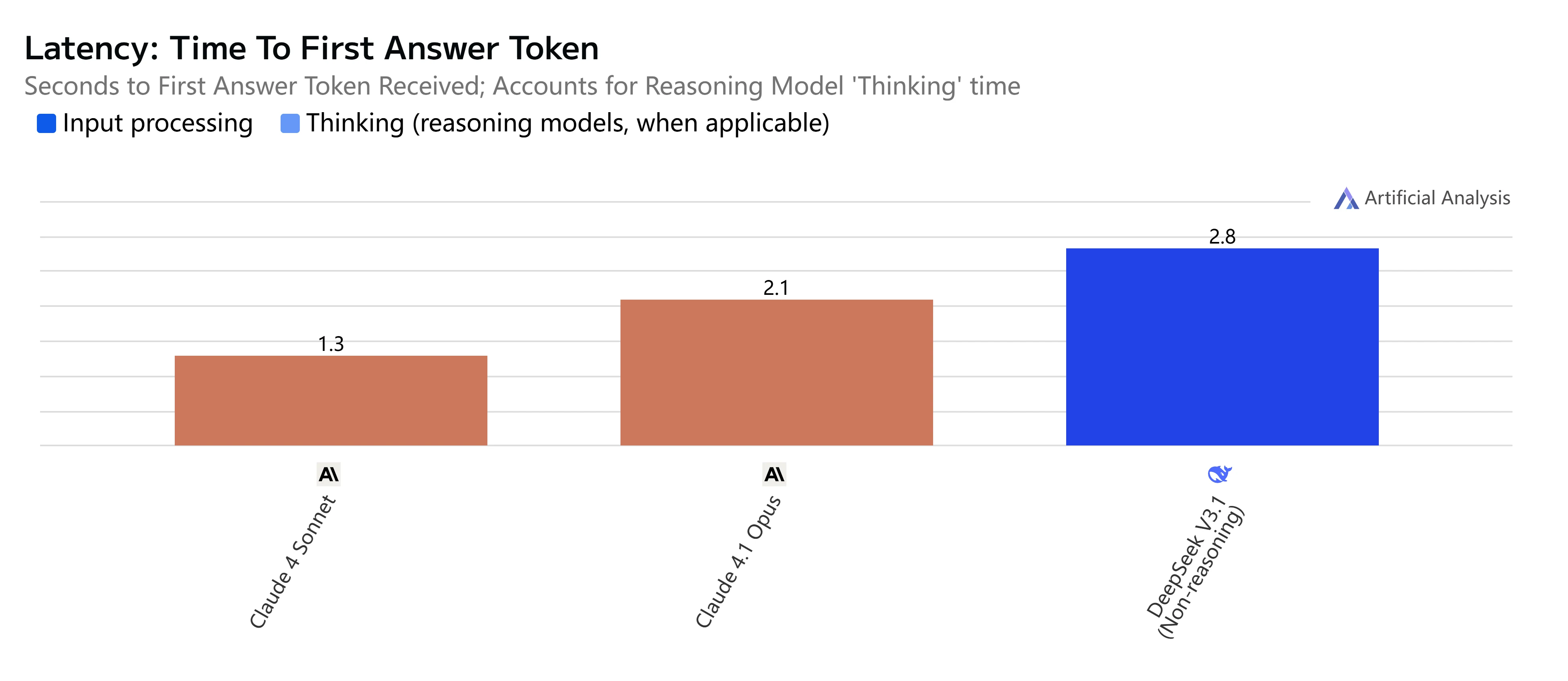
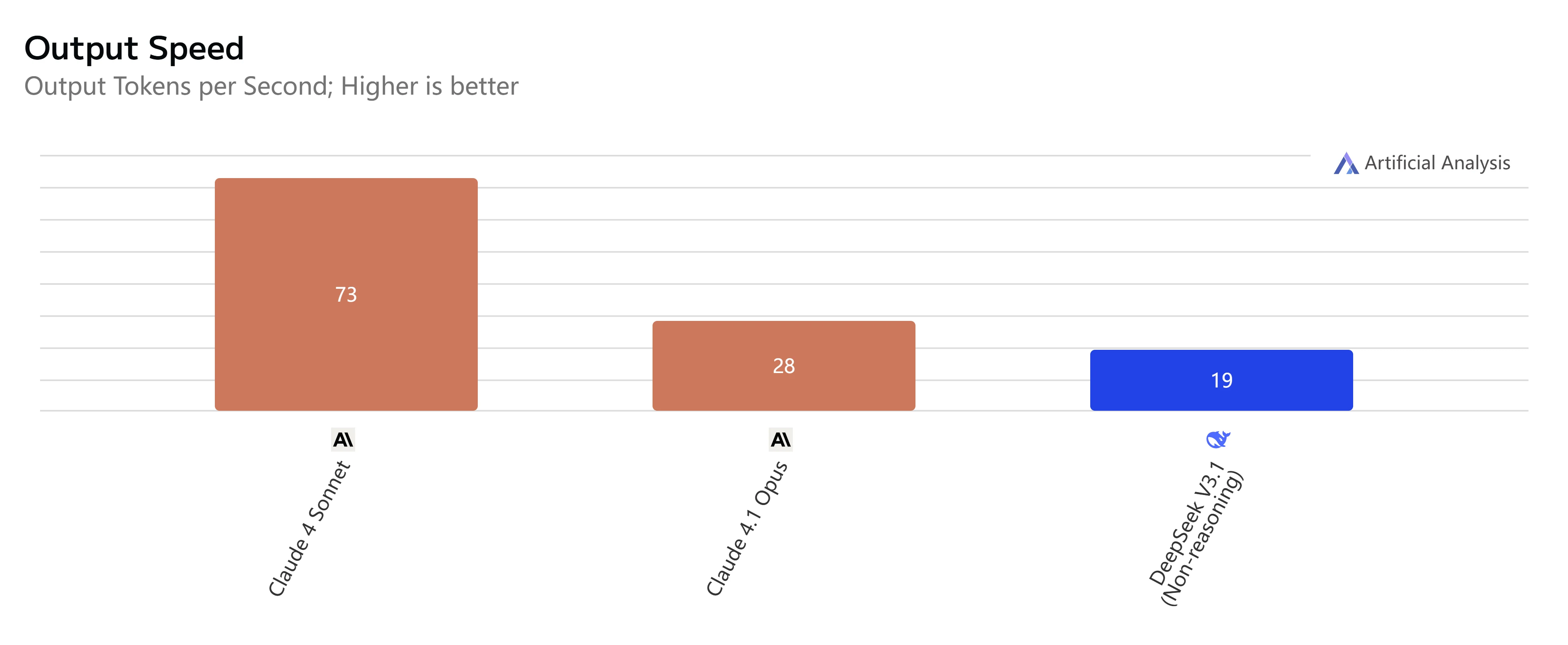
DeepSeek V3.1 vs Claude 4: Speed & Latency
DeepSeek V3.1 vs Claude 4: Use Cases
Software Development:
DeepSeek V3.1 is the better choice for most development workflows. Its ability to generate executable code, debug iteratively, and handle refactoring makes it more practical for everyday engineering tasks, especially when cost efficiency matters.
Scientific Research:
DeepSeek V3.1 clearly outperforms when it comes to scientific and technical reasoning. Its Think mode can sustain logical chains that are critical for data interpretation, simulations, and research-heavy work.
Content Creation:
Claude 4 is the superior option for high-polish, stylistically rich writing. Its natural fluency and interactive responsiveness make it better for drafting, co-creation, and applications where style and nuance are paramount. DeepSeek can scale multilingual content pipelines more cheaply, but for developers who care about quality over volume, Claude wins here.
Education & Tutoring:
DeepSeek V3.1 provides more structured, step-by-step explanations that are especially useful for building tutoring systems and interactive education tools. Claude is smoother in tone, but its explanations are less rigorous in difficult subject matter. For developers designing education platforms, DeepSeek delivers clearer value.
Conversational Applications
Claude 4 is the clear leader for dialogue-heavy use cases. Its smooth, natural phrasing and strong instruction-following make it ideal for building customer-facing chatbots where user experience is critical. DeepSeek V3.1 can serve in this role, but its responses are less fluid in casual or open-ended conversations. For developers focused on conversational AI, Claude provides a more reliable foundation.
DeepSeek V3.1 vs Claude 4: Cost
| Model | Input Price (/1M Tokens) | Output Price (/1M Tokens) |
| DeepSeek V3.1 (via Novita AI) | $0.55 | $1.66 |
| Claude 4 Opus | $15.00 | $75.00 |
| Claude 4 Sonnet | $3.00 | $15.00 |
Novita AI provides DeepSeek V3.1 APIs with 163.8K context and costs of $0.55 / 1M input Tokens and $1.66 / 1M output Tokens .
How to Access DeepSeek V3.1 on Novita AI
Novita AI provides flexible access to DeepSeek V3.1, making it easy to use across diverse scenarios. Whether for business exploration or advanced development, Novita AI equips you with the right tools.
Option 1: Use the Playground (Available Now – No Coding Required)
- Instant Access: Create an account and start experimenting with DeepSeek V3.1 in seconds.
- Interactive Interface: Test prompts and visualize outputs in real-time.
- Model Comparison: Compare DeepSeek V3.1 with other leading models for your specific use case.
The playground lets you test prompts and instantly see results, making it ideal for prototyping, experimenting with ideas, and exploring model capabilities before moving to full implementation.
Option 2: Integrate via API (For Developers)
Bring DeepSeek V3.1 into your applications with Novita AI’s unified REST API.
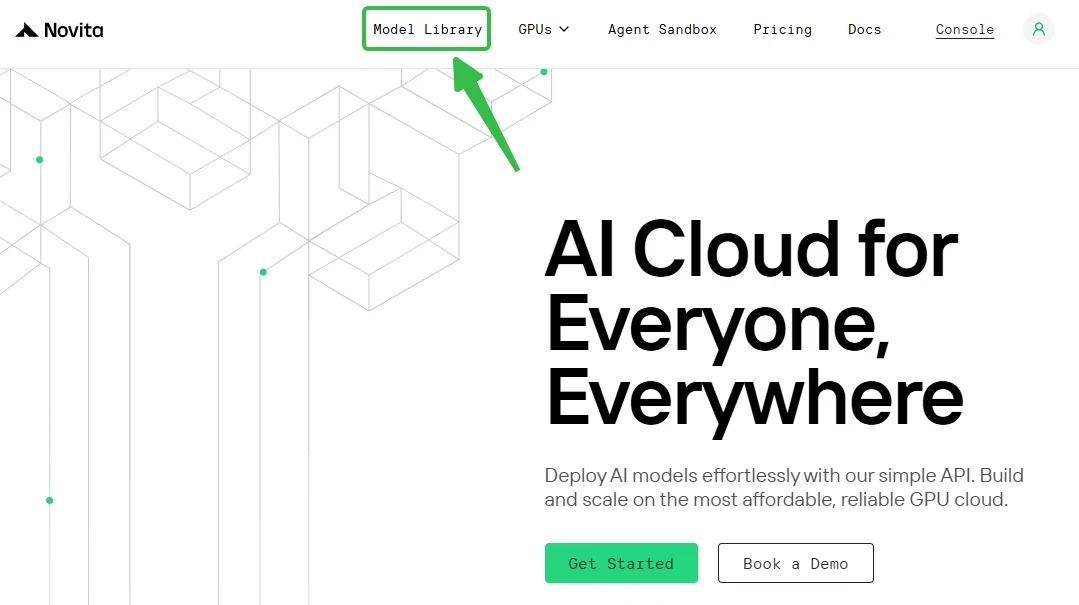
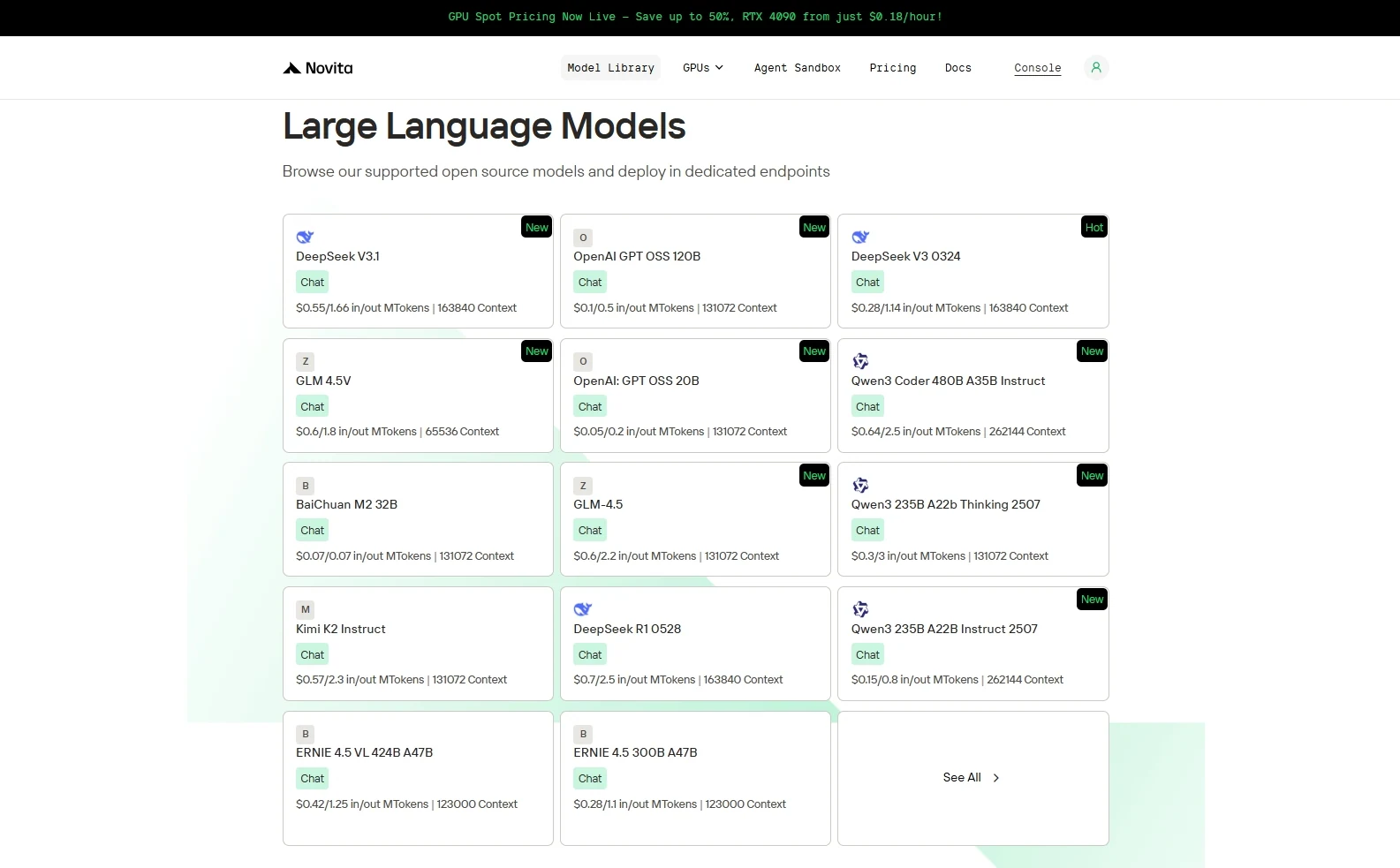
Step 1: Log In and Access the Model Library
Log in or sign up to your account and click on the Model Library button.
Step 2: Choose Your Model
Browse through the available options and select the model that suits your needs.
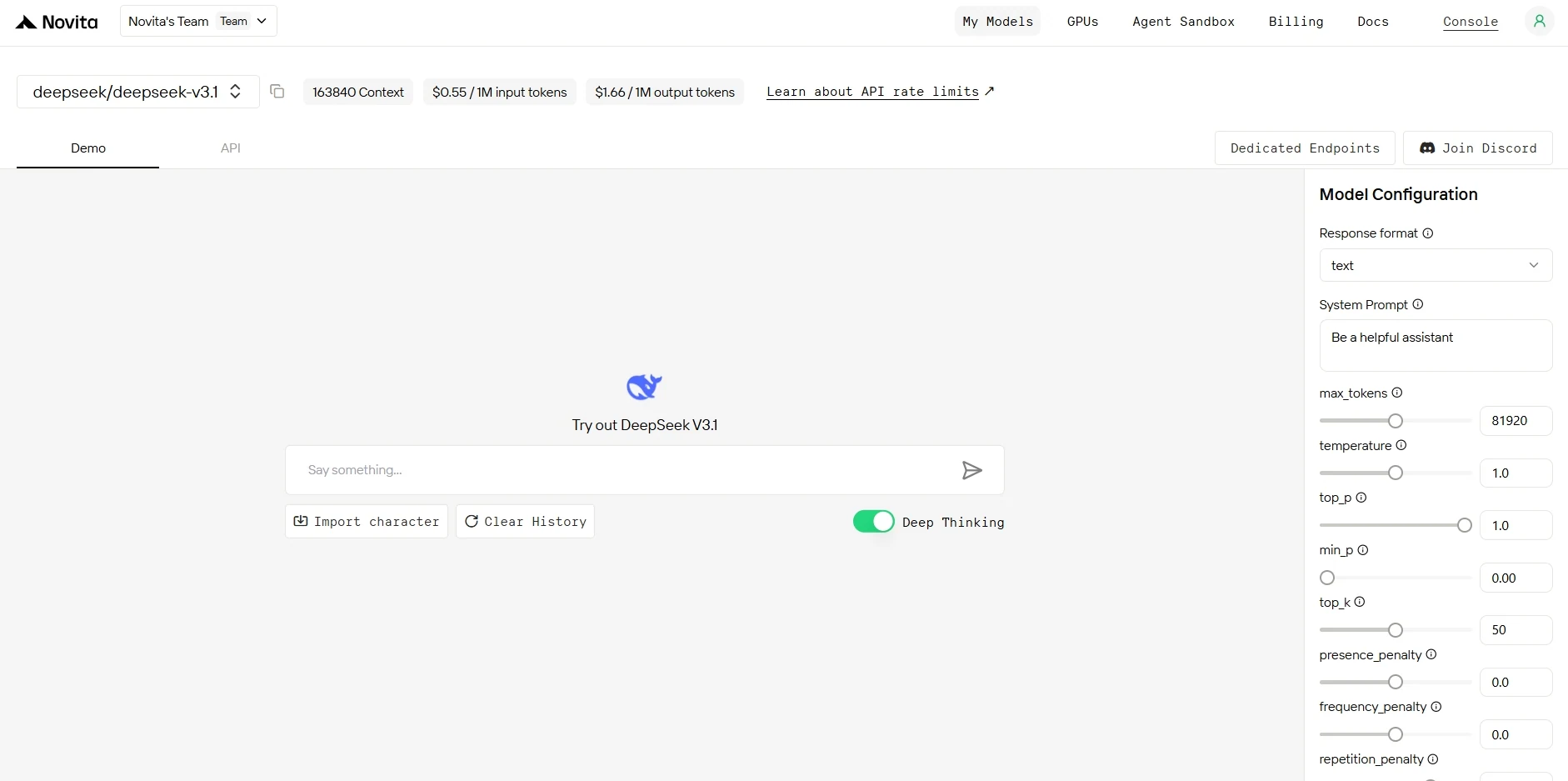
Step 3: Start Your Free Trial
Begin your free trial to explore the capabilities of the selected model.
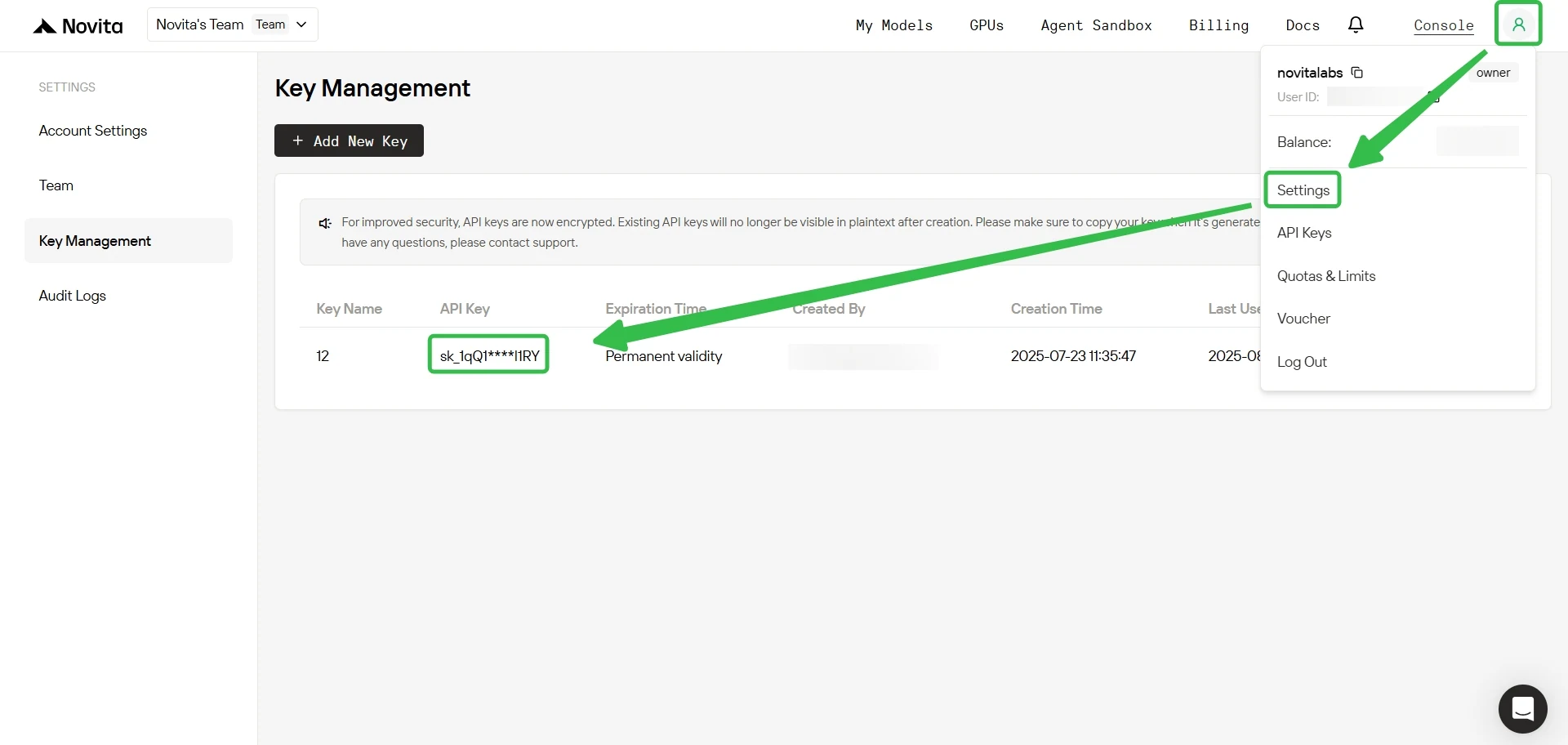
Step 4: Get Your API Key
To authenticate with the API, we will provide you with a new API key. Entering the “Settings“ page, you can copy the API key as indicated in the image.
Step 5: Install the API (Python Example)
Install API using the package manager specific to your programming language.
After installation, import the necessary libraries into your development environment. Initialize the API with your API key to start interacting with Novita AI LLM. This is an example of using chat completions API for python users.
from openai import OpenAI

client = OpenAI(
    base_url="https://api.novita.ai/openai",
    api_key="",
)

model = "deepseek/deepseek-v3.1"
stream = True # or False
max_tokens = 81920
system_content = "Be a helpful assistant"
temperature = 1
top_p = 1
min_p = 0
top_k = 50
presence_penalty = 0
frequency_penalty = 0
repetition_penalty = 1
response_format = { "type": "text" }

chat_completion_res = client.chat.completions.create(
    model=model,
    messages=[
        {
            "role": "system",
            "content": system_content,
        },
        {
            "role": "user",
            "content": "Hi there!",
        }
    ],
    stream=stream,
    max_tokens=max_tokens,
    temperature=temperature,
    top_p=top_p,
    presence_penalty=presence_penalty,
    frequency_penalty=frequency_penalty,
    response_format=response_format,
    extra_body={
      "top_k": top_k,
      "repetition_penalty": repetition_penalty,
      "min_p": min_p
    }
  )

if stream:
    for chunk in chat_completion_res:
        print(chunk.choices[0].delta.content or "", end="")
else:
    print(chat_completion_res.choices[0].message.content)
Option 3: Multi-Agent Workflows with OpenAI Agents SDK
Build sophisticated multi-agent systems leveraging DeepSeek-V3.1’s dual-mode capabilities:
- Plug-and-Play Integration: Use DeepSeek V3.1 in any OpenAI Agents workflow
- Advanced Agent Capabilities: Support for handoffs, routing, and tool integration
- Scalable Architecture: Design agents that leverage DeepSeek V3.1’s capabilities
Option 4: Connect with Other Third-Party Platform
Development Tools: Seamlessly integrate with popular IDEs and development environments like Cursor, Trae, Qwen Code, and Cline through Novita AI’s API, which is fully OpenAI-compatible. In addition, the DeepSeek V3.1 API provided by Novita AI is also Anthropic-compatible, making it possible to integrate directly within Claude Code.
Orchestration Frameworks: Connect with LangChain, Dify, CrewAI, Langflow, and other AI orchestration platforms using official connectors.
Hugging Face Integration: Novita AI serves as an official inference provider of Hugging Face, ensuring broad ecosystem compatibility.
Conclusion
DeepSeek V3.1 is a solid fit for projects that lean on heavy reasoning, advanced math, or intensive coding. It handles complex problem-solving with consistency and comes in at a lower cost, which makes it especially practical for research, analytics, and large-scale engineering work. Claude 4 feels stronger in areas that depend on smooth interaction and broad knowledge. Its conversational style, clarity, and polished writing make it the better pick for assistants, learning tools, and content-focused applications where the user experience comes first.
Frequently Asked Questions
Novita AI is an AI cloud platform that offers developers an easy way to deploy AI models using our simple API, while also providing the affordable and reliable GPU cloud for building and scaling.