AI terminology is everywhere these days, and it can be overwhelming when everyone seems to be speaking a different language. If you’ve ever been in a conversation where someone mentions “Sandbox,” “RAG,” or “MCP” and find yourself nodding along in meetings while secretly wondering what half these terms actually mean, this guide is for you.
Technology evolves rapidly, but understanding the basics doesn’t require a technical background. Here’s a straightforward breakdown of the most common AI terms you’re likely to encounter, explained in plain language and arranged to build your understanding step by step.
1. Core AI Concepts
AI models
Think of an AI model as a smart computer program designed to mimic human thinking. You give it some input—like a question or an image—and it processes that information to generate a meaningful output. Models learn by analyzing vast amounts of examples, recognizing patterns, and gradually improving their ability to understand and respond.
For a deeper dive into AI models and how to deploy them efficiently, check out our Novita AI Model Deployment Guide.
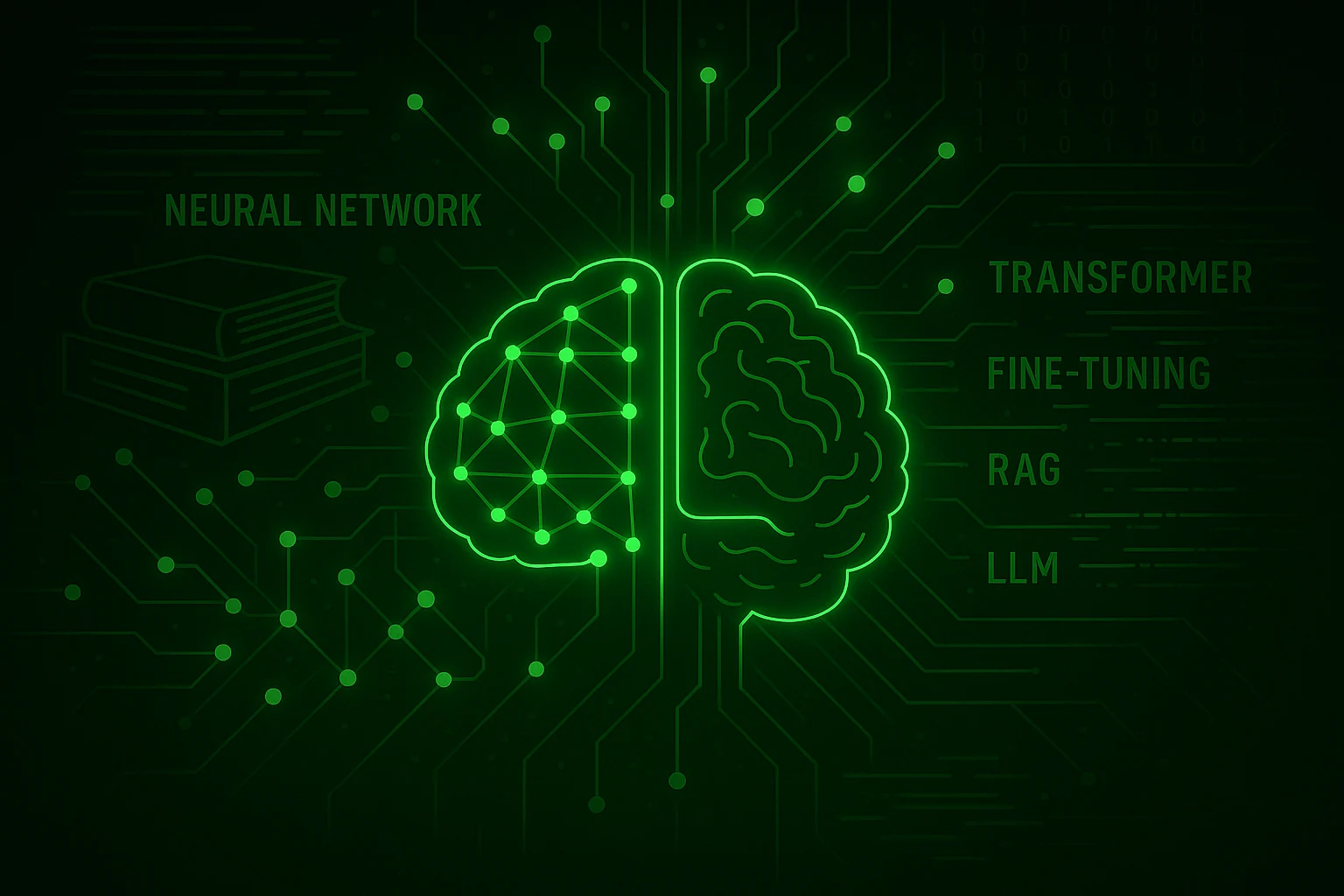
Neural Network
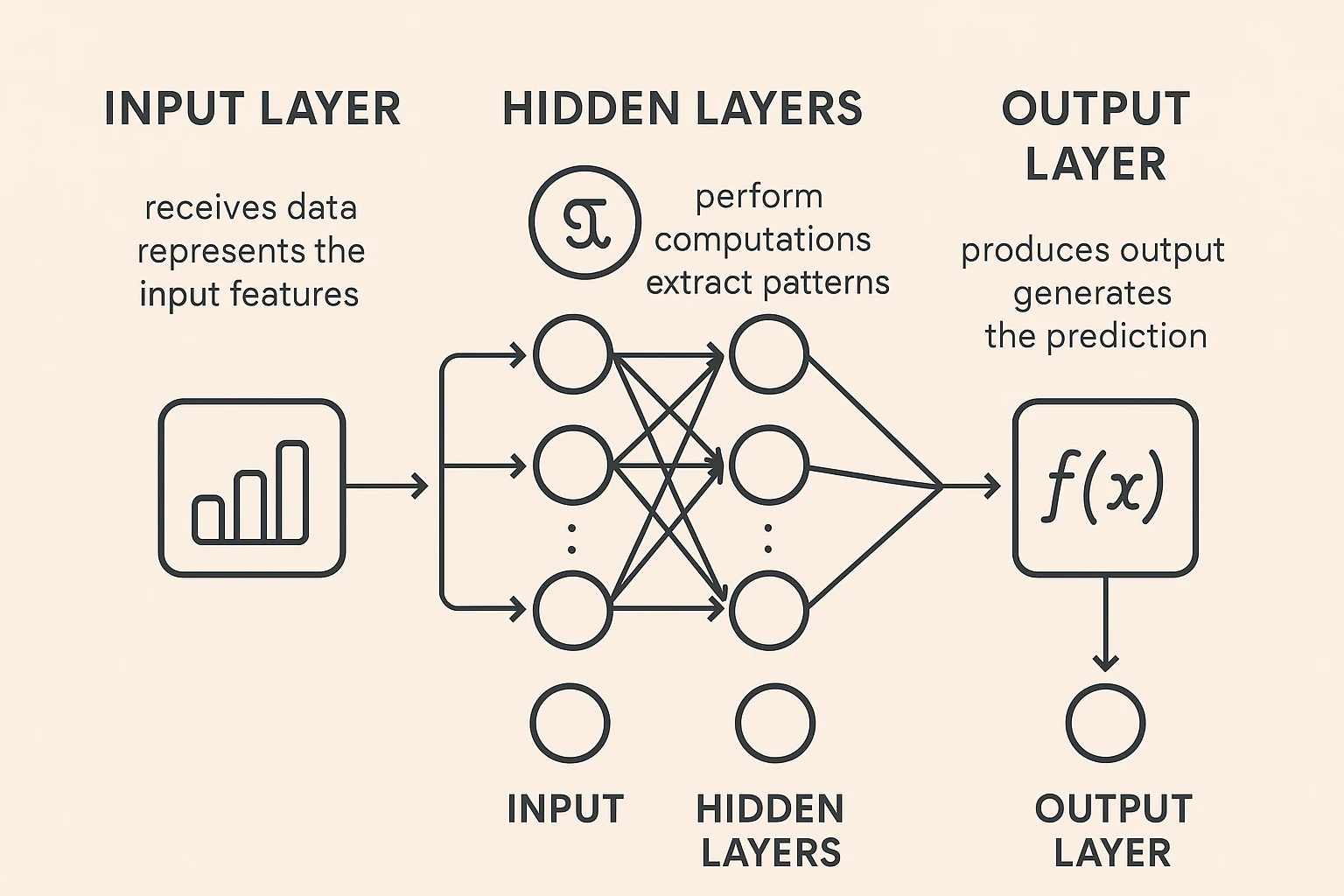
Think of a neural network as a simplified version of how our brains work. It’s made up of interconnected nodes (called artificial neurons) that pass information to each other, much like neurons in our heads. These networks get better at recognizing patterns and making decisions by adjusting the weights of connections between nodes—similar to how we learn from experience. Neural networks are organized in layers: an input layer receives data, hidden layers process it through complex mathematical functions, and an output layer produces the final result. The “deep” in deep learning refers to networks with many hidden layers, allowing them to learn increasingly complex patterns.
Transformer Architecture
The transformer is the breakthrough technology that made today’s smart AI possible. Before 2017, AI had to read text word by word, like reading a book with a finger following each word. Transformers changed this by letting AI see all the words in a sentence at once and understand how they relate to each other through a mechanism called “attention.” It’s like the difference between reading one word at a time versus grasping the whole sentence instantly. The attention mechanism allows the model to focus on relevant parts of the input when generating each part of the output, making it much more effective at understanding context and relationships in language.
Large Language Model (LLM)
LLMs are AI models trained specifically to understand and generate human language. They read billions of words and learn to predict what comes next in a sentence, enabling them to write essays, answer questions, or chat naturally. During training, they analyze patterns in text to understand grammar, context, and meaning. Modern LLMs have evolved into multi-modal models, meaning they can process not just text but also images, audio, and more—all within one interface. For example, GPT-4o can accept text, voice, and images simultaneously, making interactions richer and more versatile. The “large” refers to the enormous number of parameters (often billions) that store the model’s learned knowledge.
Artificial General Intelligence (AGI)
AGI is the holy grail of AI—a system that would be as smart as humans across every domain, not just specific tasks. While today’s AI excels at particular things like writing or image recognition, AGI would match human intelligence in creativity, reasoning, learning, and problem-solving across any field. Scientifically, achieving AGI requires solving fundamental challenges including transfer learning (applying knowledge across domains), few-shot learning (learning from minimal examples), causal reasoning, and developing more efficient learning algorithms. Current AI systems are considered “narrow” because they excel at specific tasks but lack the general intelligence and adaptability that characterizes human cognition.
AI Alignment
AI alignment is about making sure AI systems want the same things humans want and behave in ways that help rather than harm us. As AI becomes more powerful, ensuring it shares our values and goals becomes increasingly important. Think of it as making sure AI is on our team. This involves technical challenges like value learning (teaching AI to understand human preferences), robustness (ensuring AI behaves correctly in new situations), and interpretability (understanding why AI makes certain decisions). Alignment research also addresses philosophical questions about whose values to align with and how to handle conflicting human preferences.
2. Data and Training
Training Data
Training data is simply all the information used to teach an AI model—think of it as the AI’s textbooks. For language models, this includes millions of books, websites, news articles, and other written content. The more diverse and high-quality this “reading material” is, the better the AI becomes at handling different topics and situations. Data quality is crucial: biased or incorrect training data leads to biased or incorrect AI outputs. The training process involves showing the model countless examples so it can learn statistical patterns and relationships within the data.
Pre-training
Pre-training is like AI going to elementary school—it’s where models learn the basics. During this phase, AI reads massive amounts of text and learns fundamental patterns about language, facts about the world, and how to reason. It’s essentially the AI’s general education before it specializes in anything specific. Pre-training uses unsupervised learning, meaning the model learns patterns without explicit labels or answers. This phase is computationally expensive, often requiring weeks or months on powerful computer clusters, but it creates a foundation of general knowledge that can be applied to many different tasks.
Fine-tuning
Fine-tuning is like specialized training after graduation. Once an AI has its general education through pre-training, it can be trained further on specific types of content or tasks. For instance, a general AI might be fine-tuned on medical journals to become better at healthcare questions, or trained on customer service conversations to adopt a company’s particular tone and style. This process requires much less data and computational resources than pre-training because the model already understands language fundamentals. Fine-tuning adjusts the model’s parameters to optimize performance for specific domains or applications while preserving general capabilities.
Reinforcement Learning from Human Feedback (RLHF)
RLHF is like having human teachers grade the AI’s homework and tell it what makes a good answer. Humans rate different AI responses, and the model learns to produce outputs that people find helpful, accurate, and appropriate. This process is crucial for making AI systems that behave the way we want them to. RLHF typically involves three steps: training a reward model based on human preferences, using reinforcement learning to optimize the AI’s behavior according to this reward model, and iteratively improving through more human feedback. This technique helps align AI behavior with human values and reduces harmful or unwanted outputs.
3. Input and Output Mechanisms
Token
A token is basically how AI “counts” text—roughly one token per word, though it can be parts of words, punctuation, or even spaces. AI models have limits on how many tokens they can handle at once (called the context window), which is why sometimes they can’t process very long documents or remember everything from a lengthy conversation. Different languages and writing systems require different tokenization strategies. Understanding tokens is important because AI models process text sequentially as tokens, and the token limit determines both input length and memory span during conversations.
Inference
Inference is simply the moment when AI is doing its job—taking your input and producing an output. When you type a question into ChatGPT and get an answer back, that’s inference happening. It’s different from training, which is when the AI is learning from data. During inference, the model uses its learned parameters to process new inputs and generate responses. This process is much faster and less resource-intensive than training, but still requires significant computational power for large models. The quality of inference depends on both the model’s training and how well the input matches patterns the model has seen before.
Prompt Engineering
Prompt engineering is the art and science of asking AI the right question in the right way. Just like how asking a person a clear, specific question gets you a better answer than a vague one, crafting good prompts can dramatically improve what you get from AI. Effective prompts often include clear instructions, relevant context, examples of desired output format, and specific constraints or requirements. Advanced techniques include chain-of-thought prompting (asking the AI to show its reasoning), few-shot learning (providing examples), and prompt chaining (breaking complex tasks into steps). The goal is to communicate intent clearly while leveraging the model’s capabilities optimally.
Hallucination
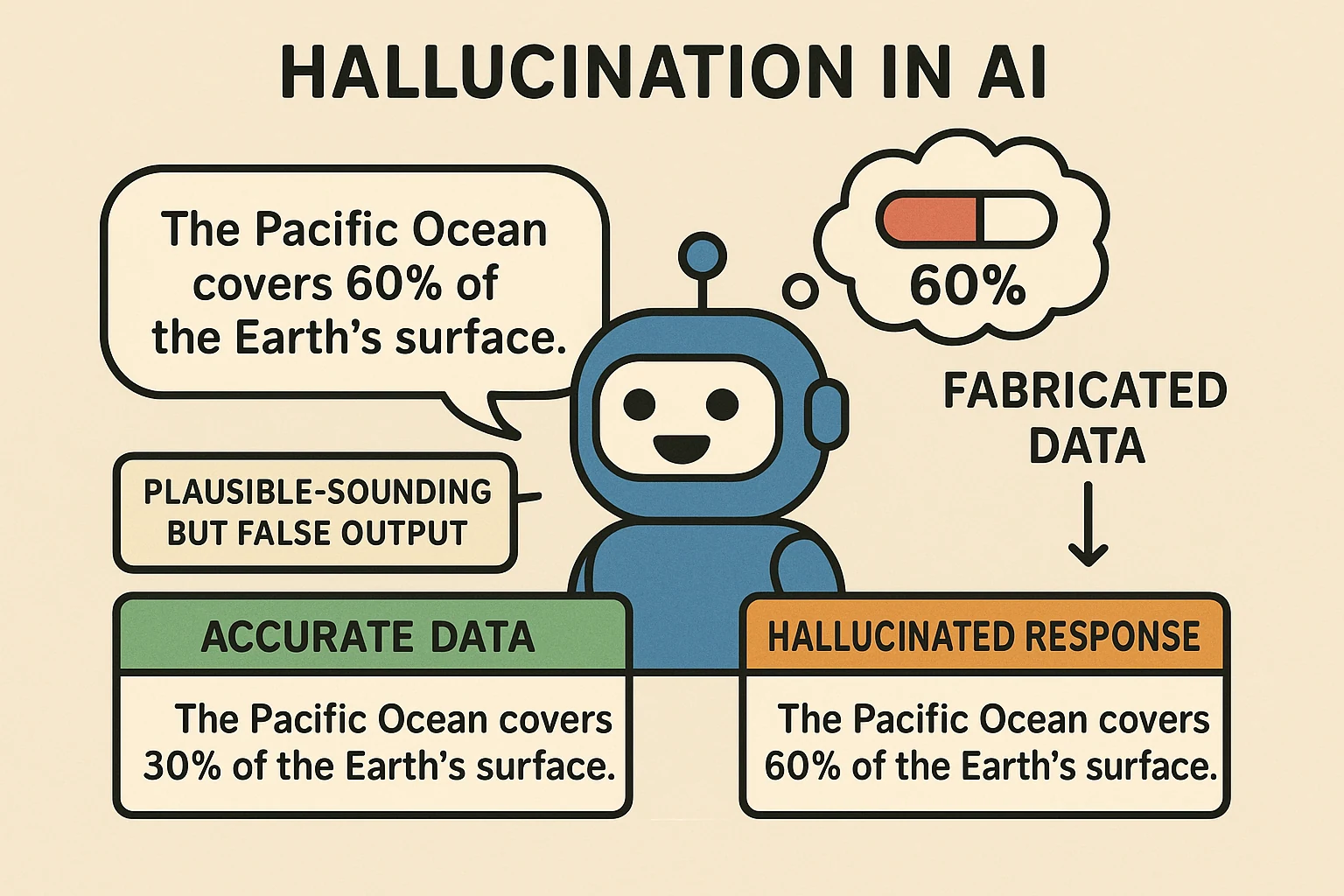
When AI “hallucinates,” it’s making things up that sound convincing but aren’t true. This happens when AI tries to fill in gaps in its knowledge or gets asked about something it doesn’t really understand. It’s like when someone confidently gives you directions to a place they’ve never been—the confidence doesn’t make the directions correct. Hallucinations occur because language models are trained to generate plausible-sounding text, not necessarily accurate information. They can fabricate facts, citations, or details while maintaining a confident tone. Understanding this limitation is crucial for responsible AI use, and techniques like fact-checking and source verification remain important.
4. AI Tools and Advanced Applications
Application Programming Interface (API)
An API is like a waiter in a restaurant—it takes your order (request) to the kitchen (AI system) and brings back your food (response). In the AI world, APIs let different software programs talk to AI models without having to build the AI from scratch. Companies can plug into existing AI services through APIs. APIs define the specific format for requests and responses, including parameters like maximum output length, creativity level (temperature), and response format. They handle authentication, rate limiting, and error management, making it easy for developers to integrate AI capabilities into applications, websites, or services without needing deep AI expertise.
Multimodal AI
Multimodal AI can handle different types of content all at once—text, images, voice, and video. It’s like having a conversation with someone who can see what you’re showing them, hear what you’re saying, and read what you’ve written, all simultaneously. This makes AI interactions feel much more natural and human-like. Multimodal models use different neural network architectures for different input types (vision transformers for images, audio encoders for sound) but combine them in a unified representation space. This allows the AI to understand relationships between different modalities, like describing what’s happening in a video or answering questions about images.
Retrieval-Augmented Generation (RAG)
RAG is like giving AI access to a current library while it’s answering your questions. Instead of only using what it learned during training, RAG systems can search through up-to-date databases and documents to find relevant information before crafting a response. This helps ensure answers are accurate and current. RAG works in two steps: first, a retrieval system searches for relevant documents or information based on the query, then the language model generates a response using both its training knowledge and the retrieved information. This approach reduces hallucinations, enables access to current information, and allows AI to work with proprietary or specialized knowledge bases.
This article helps you learn more: What is RAG: A Comprehensive Introduction to Retrieval Augmented Generation
Sandbox
A sandbox is like a secure playpen for AI—a safe, isolated environment where AI can run code, access tools, or experiment without any risk to your main systems. It’s like letting a child play in a gated area where they can’t break anything important. Sandboxes use containerization, virtual machines, or other isolation technologies to create controlled environments with limited access to system resources, network connections, and sensitive data. This allows AI agents to execute code, interact with APIs, or test solutions while preventing potential security breaches, data corruption, or system damage.
This is a rather complicated concept, if you’re want to explore more, here’s an awesome article by us to dive deeper into it:How Agent Sandboxes Power Secure, Scalable AI Innovation.
LLM Dedicated Endpoint
An LLM dedicated endpoint is like having a direct phone line to a specific AI model, optimized for your particular needs. Instead of sharing resources with everyone else, you get a dedicated connection that can be customized for your specific use case. This involves setting up isolated computing resources (GPUs, memory, bandwidth) with custom configurations like response speed, output style, safety filters, and performance guarantees. Dedicated endpoints provide consistent latency, higher throughput, and the ability to fine-tune models specifically for your applications while ensuring data privacy and meeting enterprise security requirements.
This article helps you learn more: LLM Dedicated Endpoint on Novita AI: Custom Models, Usage-Based Pricing, and DevOps-Free Scaling.
Model Context Protocol (MCP)
MCP is an emerging standard that lets AI models connect with external tools and services in a consistent way. Instead of just generating text, AI can now schedule your meetings, update your calendar, or pull information from your databases. From a technical standpoint, MCP creates a standardized communication protocol that allows AI to safely interact with different software systems through defined interfaces and permissions. This transforms AI from a passive responder into an active assistant that can take real actions while maintaining security through controlled access patterns and audit trails.
Here’s an article helps you learn more:What is MCP? A Developer’s Guide to Model Context Protocol .
Artificial Intelligence is a rapidly evolving field that combines foundational concepts, advanced tools, and ethical considerations to create powerful systems capable of transforming industries. As AI continues to advance, staying informed about its concepts and applications is key to unlocking its full potential.Transitioning to hands-on practice is also a great way to stay tuned with the latest developments and gain practical experience.
For a limited time, new users can claim $10 in free credits to explore and build with the LLM API on Novita AI. Don’t miss this opportunity to dive into the world of AI and bring your ideas to life!
About Novita AI
Novita AI is an AI cloud platform that offers developers an easy way to deploy AI models using our simple API, while also providing an affordable and reliable GPU cloud for building and scaling.