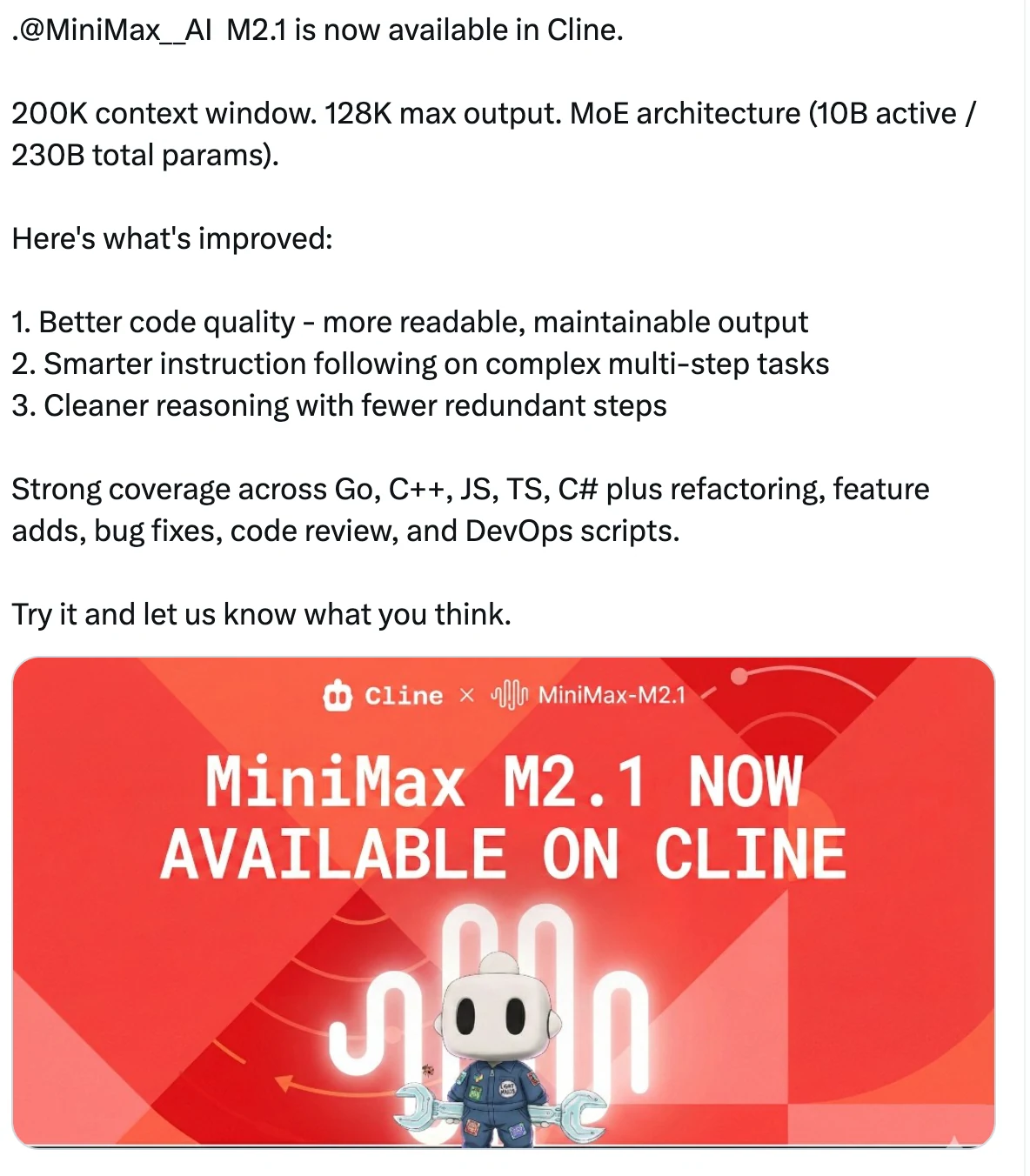
MiniMax M2.1’s release on December 23, 2025 introduced a paradox: a 230B-parameter model (10B active via MoE) delivering SOTA coding performance at $0.27-$0.30 per million input tokens.
This analysis examines the technical and economic trade-offs across six MiniMax M2.1 api providers on OpenRouter. We’ll explore why the “cheapest” option costs 15% less than premium alternatives—and whether that savings justifies the constraints.
How to Choose an API Provider?
When evaluating MiniMax M2.1 providers, four factors dominate decision-making:
1. Total Cost (Input + Output Combined)
The true cost of an API provider comes from input tokens + output tokens combined. While input prices cluster tightly, output varies significantly. For a typical workload of 10M input + 5M output tokens:
- AtlasCloud: $2.90 + $4.75 = $7.65
- Inceptron: $2.70 + $5.50 = $8.20
- NovitaAI: $3.00 + $6.00 = $9.00
Cache read support—which can reduce costs by 90% for repeated prompts—is only offered by three providers (AtlasCloud, MiniMax Official, NovitaAI) at $0.03-$0.14/M.
Cache reads are cheap because the provider can reuse precomputed KV cache states for an identical prompt prefix, skipping the entire prompt prefill stage, including tokenization, attention computation, and cache construction, which removes most of the computational work and reduces inference cost by up to 90%.
2. Latency & Throughput
Time-to-first-token (latency) ranges from 0.41s (DeepInfra) to 3.43s (NovitaAI), while throughput spans 22-60 tokens per second. Real-time applications like coding assistants demand sub-second latency, whereas batch processing benefits more from high throughput.
3. Uptime & Reliability
Uptime ranges from 52.5% (Inceptron) to 99.9% (NovitaAI). For production systems, anything below 99% creates unacceptable service interruptions. Development and prototyping can tolerate lower reliability in exchange for cost savings.
4. Context Window & Max Output
Most providers support 196.6K context, but MiniMax Official and NovitaAI offer 204.8K. Max output varies more dramatically: AtlasCloud limits outputs to 65.5K tokens, while others support 131.1K-196.6K.
The Three Core Trade-offs of Minimax M2.1 API Providers
Trade-off 1: Cost vs Output Capacity
AtlasCloud’s Strategy: Achieve lowest total cost ($7.65 for 10M+5M tokens) by capping max output at 65.5K tokens. According to DigitalApplied’s guide, 99% of coding tasks generate < 50K output tokens, making this limitation irrelevant for most workloads. But documentation generation and multi-file refactoring can hit this ceiling.
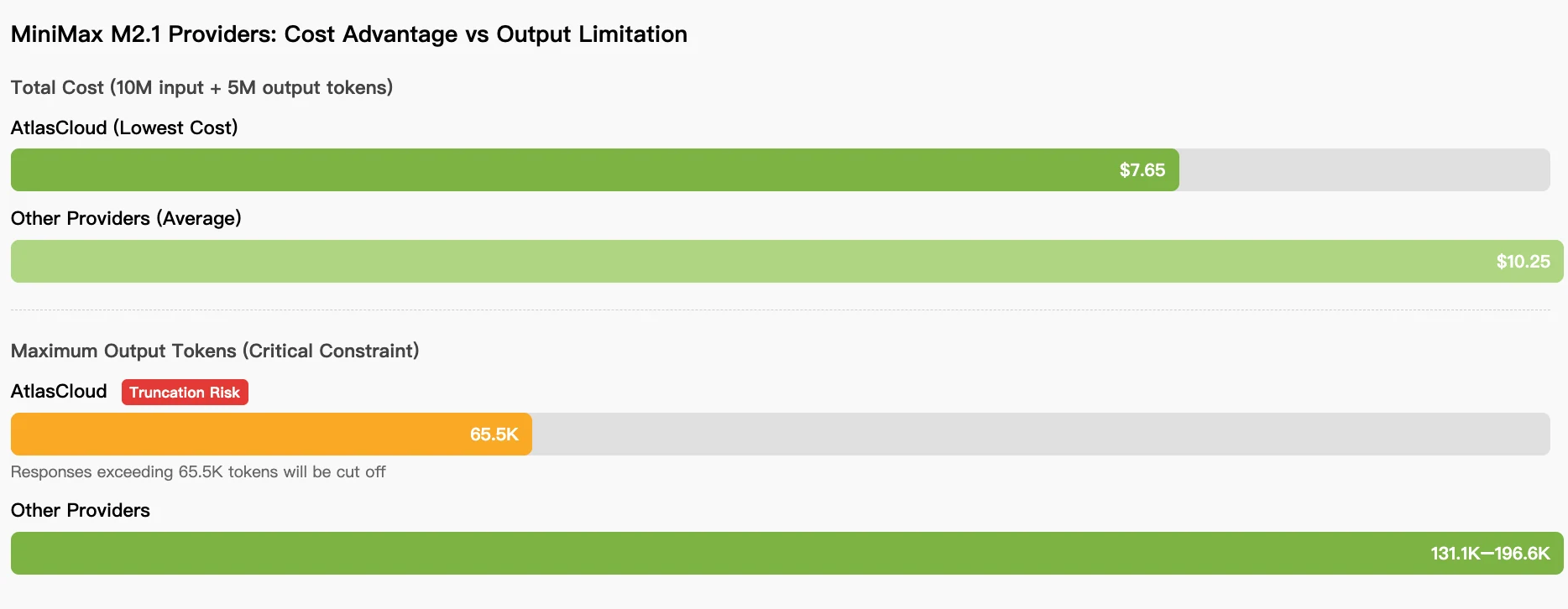
For code agents, AtlasCloud’s 65.5K max output limit represents a clear but manageable trade-off: the vast majority of agent actions, including code edits, function generation, test writing, and incremental refactors, produce far less than 50K output tokens, so the cap rarely triggers in normal operation while delivering the lowest overall cost.
The limitation becomes relevant only when agents attempt output-heavy actions such as full project documentation, large multi-file rewrites, or verbose architectural explanations, where responses can be truncated and require chunking or fallback routing to a higher-cap provider. In practice, this makes AtlasCloud well suited as a primary provider for cost-sensitive, high-frequency code agent workloads, with explicit safeguards for rare long-form outputs.
Trade-off 2: Latency vs Reliability
DeepInfra delivers 0.4–0.6 s time-to-first-token with around 99.3 % uptime, whereas NovitaAI’s latency figures on comparable models can be several times higher, but with 99.9 %+ uptime — equating to significantly less expected downtime over a year in production. This illustrates a deliberate trade-off where slightly higher latency is accepted in exchange for greater reliability and lower risk of service interruption.


From Openrouter
Trade-off 3: Throughput vs Stability
SiliconFlow’s Bet: Deliver 60 tokens/second throughput with 79.7% uptime, optimizing for batch processing over reliability. Total cost of $8.90 positions it between budget and premium tiers.
According to AiCybr’s deployment analysis, high-throughput providers like SiliconFlow achieve this through:
- Larger batch sizes: Process multiple requests concurrently, increasing throughput but adding latency
- Aggressive model sharding: Distribute inference across GPUs, improving parallelism
- Singapore region: Lower labor/infrastructure costs enable competitive pricing
With an uptime of 79.7%, the service is too unstable for user-facing production workloads, but it can still be viable for internal CI/CD pipelines where failures are expected and handled through automatic retries.
Provider-by-Provider Analysis of Minimax M2.1
1. AtlasCloud - Best for Cost-Optimized Production But Not Agent
AtlasCloud achieves the lowest total cost among reliable providers at $7.65 (10M+5M tokens) through aggressive output pricing ($0.95/M) while maintaining production-acceptable 89.8% uptime.
Why Choose AtlasCloud:
Atlas Cloud differentiates itself through a combination of:
- A unified multi-model API
- Elastic GPU scaling and serverless inference
- Built-in multimodal workflow support
- Integrated fine-tuning and model management
- Enterprise-grade governance
- Cost-efficient execution and billing
These innovations make Atlas Cloud attractive for developers building scalable, production-grade AI applications across language, vision, audio, and video domains without managing complex infrastructure stacks.
Pricing
- Input: $0.29 per 1M tokens
- Output: $0.95 per 1M tokens
- Cache: $0.03 per 1M tokens
Code Example:
import requests

url = "https://api.atlascloud.ai/v1/chat/completions"
headers = {
    "Content-Type": "application/json",
    "Authorization": "Bearer $ATLASCLOUD_API_KEY"
}
data = {
    "model": "minimaxai/minimax-m2.1",
    "messages": [
        {
            "role": "user",
            "content": "what is difference between http and https"
        }
    ],
    "max_tokens": 32768,
    "temperature": 1,
    "stream": True
}

response = requests.post(url, headers=headers, json=data)
print(response.json())
Best For:
- Startups optimizing burn rate
- Production coding but not code agent assistants.
- Applications with < 80% output-to-input token ratio
2. Novita AI - Best for Mission-Critical Production
NovitaAI’s 99.9% uptime translates to just 8.7 hours of annual downtime—compared to 61 hours for DeepInfra and 886 hours for AtlasCloud. For mission-critical applications where availability trumps latency, the $9.00 total cost buys enterprise-grade reliability.
Why Choose Novita AI:
- Security and Compliance: As a cloud provider, it includes standard encryption and API key auth; no major breaches reported in reviews.
- Ease of Integration and Documentation: Documentation covers completions and chat endpoints effectively. By using Novita AI’s service, you can bypass the regional restrictions ofClaude Code. Novita also provides SLA guarantees with 99% service stability, making it especially suitable for high-frequency scenarios such as code generation and automated testing.Meanwhile, you can easily connect Novita AI with partner platforms like Continue, AnythingLLM,LangChain, Dify and Langflow through official connectors and step-by-step integration guides. In addition to Minimax M2.1, users can also access powerful coding models like Kimi-k2 and Qwen3 Coder, whose performance is close to Claude’s closed-source Sonnet 4, at less than one-fifth of the cost.
- Support and Community: 24/7 support via Discord and email, with active X presence for updates; community feedback on Reddit praises affordability but notes occasional quality dips compared to official APIs.
- Vendor Experience and Functionality: Experienced in LLM APIs and GPU cloud, Novita excels in code-specific features like function calling.
Pricing
- Input: $0.30 per 1M tokens
- Output: $1.20 per 1M tokens
- Cache: $0.03 per 1M tokens
Code Example:
from openai import OpenAI

client = OpenAI(
    api_key="<Your API Key>",
    base_url="https://api.novita.ai/openai"
)

response = client.chat.completions.create(
    model="minimax/minimax-m2.1",
    messages=[
        {"role": "system", "content": "You are a helpful assistant."},
        {"role": "user", "content": "Hello, how are you?"}
    ],
    max_tokens=131072,
    temperature=0.7
)

print(response.choices[0].message.content)
Best For:
- Production applications requiring 99.9%+ SLA
- Revenue-generating products where downtime costs exceed API savings
- Enterprise deployments with strict availability requirements
- Long-context tasks (204.8K window)
- Applications with high prompt reuse.
3.MiniMax Official - Best for Extended Context & Official Support
Why Choose MiniMax Official
- Immediate feature access: New M2.1 capabilities (improved tool calling, reasoning optimizations) available day-of-release, vs weeks of lag for third-party providers
- Model-specific optimizations: MiniMax can tune official API for M2.1’s specific architecture (MoE routing, attention patterns)
- Direct troubleshooting: Issues traced to model behavior vs infrastructure problems
Extended Context Use Cases
The 204.8K context window enables:
- Full codebase analysis: 200K tokens = 50,000-80,000 lines of code (entire small-to-medium projects)
- Long document processing: Technical specifications, legal contracts
- Multi-turn conversations: Extended debugging sessions without losing context
Pricing
- Input: $0.30 per 1M tokens
- Output: $1.20 per 1M tokens
- Cache: $0.03 per 1M tokens
Code Example:
import anthropic

client = anthropic.Anthropic()

message = client.messages.create(
    model="MiniMax-M2.1",
    max_tokens=1000,
    system="You are a helpful assistant.",
    messages=[
        {
            "role": "user",
            "content": [
                {
                    "type": "text",
                    "text": "Hi, how are you?"
                }
            ]
        }
    ]
)

for block in message.content:
    if block.type == "thinking":
        print(f"Thinking:\
{block.thinking}\
")
    elif block.type == "text":
        print(f"Text:\
{block.text}\
")
Best For:
- Applications requiring 200K+ context (full codebase analysis)
- Teams needing official support and direct troubleshooting
- Organizations wanting guaranteed feature parity with new releases
Performance Comparison of Minimax M2.1 Providers
| Provider | Total Cost | Latency | Throughput | Uptime | Cache |
|---|---|---|---|---|---|
| AtlasCloud | $7.65 🥇 | 0.96s | 22 tps | 89.8% | $0.03/M |
| DeepInfra | $8.80 | 0.41s ⚡ | 23 tps | 99.3% | $0.14/M |
| Inceptron | $8.20 | 0.51s | 39 tps | 52.5% ⚠️ | — |
| SiliconFlow | $8.90 | 2.20s | 60 tps 🚀 | 79.7% | — |
| MiniMax Official | $9.00 | 2.93s | 35 tps | 99.7% | $0.03/M |
| NovitaAI | $9.00 | 3.43s | 28 tps | 99.9% ✅ | $0.03/M |
Final Recommendation for Commercial Minimax M2.1 Production
For commercial, user-facing production systems, reliability consistently outweighs both cost and raw latency. In this context, NovitaAI is the most appropriate default choice.
With 99.9% uptime, NovitaAI offers an order-of-magnitude reduction in request-level failures compared to lower-availability providers. In real production environments, this translates directly into fewer user-visible errors, lower operational overhead, and reduced need for complex retry, fallback, or incident-response logic. While its 3.43s time-to-first-token is slower than DeepInfra, this latency is often acceptable for most commercial applications once responses are streamed, cached, or amortized across longer interactions.
The $1.35/month premium over AtlasCloud is negligible at commercial scale when weighed against the cost of degraded user experience, on-call engineering time, and SLA risk. Additionally, NovitaAI’s 204.8K context window and aggressive $0.03/M cache pricing make it especially well suited for production workloads involving long contexts, retrieval-augmented generation, and multi-step agent workflows.
In practice, AtlasCloud remains a strong option for cost-sensitive or internal workloads, and DeepInfra excels in latency-critical interactive tools. However, when moving from experimentation to commercial deployment, where uptime, predictability, and contractual reliability matter most, NovitaAI is the safer and more scalable production choice.
Frequently Asked Questions
Should I use OpenRouter or integrate providers directly?
Go direct once spend exceeds $50K and you have DevOps capacity to manage reliability yourself. OpenRouter adds about 40ms latency, which only matters for sub-100ms use cases.
How much does cache support really save?
Up to 90% on repeated prompts. With cache priced at $0.03/M instead of $0.30/M input, every 10M cached tokens saves about $2,700 per month. For agent workflows with large system prompts, cache savings quickly dominate all other cost differences.
Why is AtlasCloud cheaper?
Lower output pricing ($0.95/M) comes from a 65.5K max output limit. This doesn’t affect over 99% of coding tasks, which stay under 50K tokens.
Novita AI is an AI cloud platform that offers developers an easy way to deploy AI models using our simple API, while also providing an affordable and reliable GPU cloud for building and scaling.
Recommend Reading