Google just dropped Gemini 2.5 Pro(06-05), and it’s rewriting the rules of AI-powered coding. This latest model dominates challenging programming benchmarks like Aider Polyglot, while simultaneously excelling in GPQA and the “Humanity’s Last Exam” (HLE)—tests that evaluate mathematical reasoning, scientific knowledge, and complex problem-solving at levels that challenge even human experts.
But here’s the reality: while Google pushes boundaries with Gemini 2.5, OpenAI counters with GPTo4-mini’s performance, and open-source alternatives like DeepSeek R1 are closing the gap at a fraction of the cost. The AI coding landscape is as dynamic as ever. But amidst this flurry of innovation, the key question remains: Which tool works best for your unique needs?
This article cuts through the noise, offering a clear and practical comparison of the Top 6 LLM APIs for Coding in 2025. If you are comparing packaged coding tools as well as APIs, see Best AI Coding Tools in 2026. Whether you’re a developer searching for tools to streamline your coding process or a business or enterprise leader exploring solutions to optimize your team’s workflows, this article provides a practical, in-depth comparison of leading open-source and proprietary LLM APIs.
Highlights:Top LLM APIs for Coding (2025)
Often, a single API cannot meet all your needs. Different tasks require different models—some for speed, others for accuracy, multilingual support, or cost-efficiency. This is where an API cloud platform excels: allows you to choose the best tool for each specific task without vendor lock-in.
Novita AI is an AI cloud platform that offers developers an easy way to deploy these AI models using simple API, while also providing the affordable and reliable GPU cloud for building and scaling. It stands out with competitive pricing, a diverse selection of models, and seamless integration options.
Start a free trial on Novita AI today to easily access all these LLM APIs.
1. LLM APIs for Coding: Overview and Common Use Cases
What is an LLM API?
A Large Language Model Application Programming Interface (LLM API) is a request-response-based interface that facilitates the integration of large language models(LLMs) into software systems. Instead of building and training complex models from scratch, developers can call these APIs to automate and accelerate various coding tasks. This makes LLM APIs indispensable tools in modern software development, enabling smarter, faster, and more efficient coding workflows.
Common Coding Use Cases for LLM APIs
LLM APIs revolutionize coding by simplifying access to advanced AI models and enhancing developer productivity:
- Simplified Model Access: Lower the barrier to entry by providing easy interaction with powerful AI models, even without deep AI expertise.
- Code Generation & Autocompletion: Generate contextually relevant code, from snippets to complex functions, to accelerate development.
- Bug Detection & Fixes: Identify and resolve potential bugs faster by analyzing code patterns.
- Refactoring & Optimization: Improve code structure and performance, making it cleaner and more maintainable.
- Test Case & Documentation Generation: Automate unit tests and documentation, boosting reliability and clarity.
- Code Translation: Seamlessly translate code between languages to enable cross-platform development.
2. Open Source LLM APIs for Coding
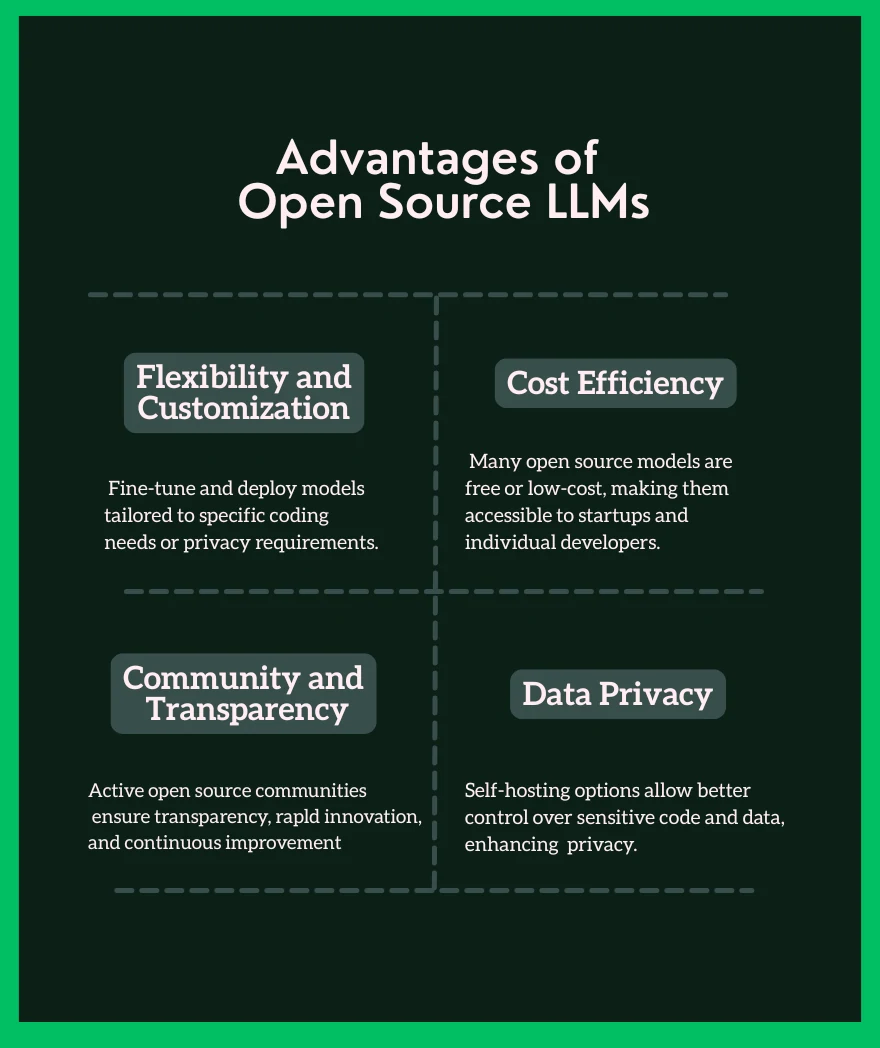
Advantages of Open Source LLMs
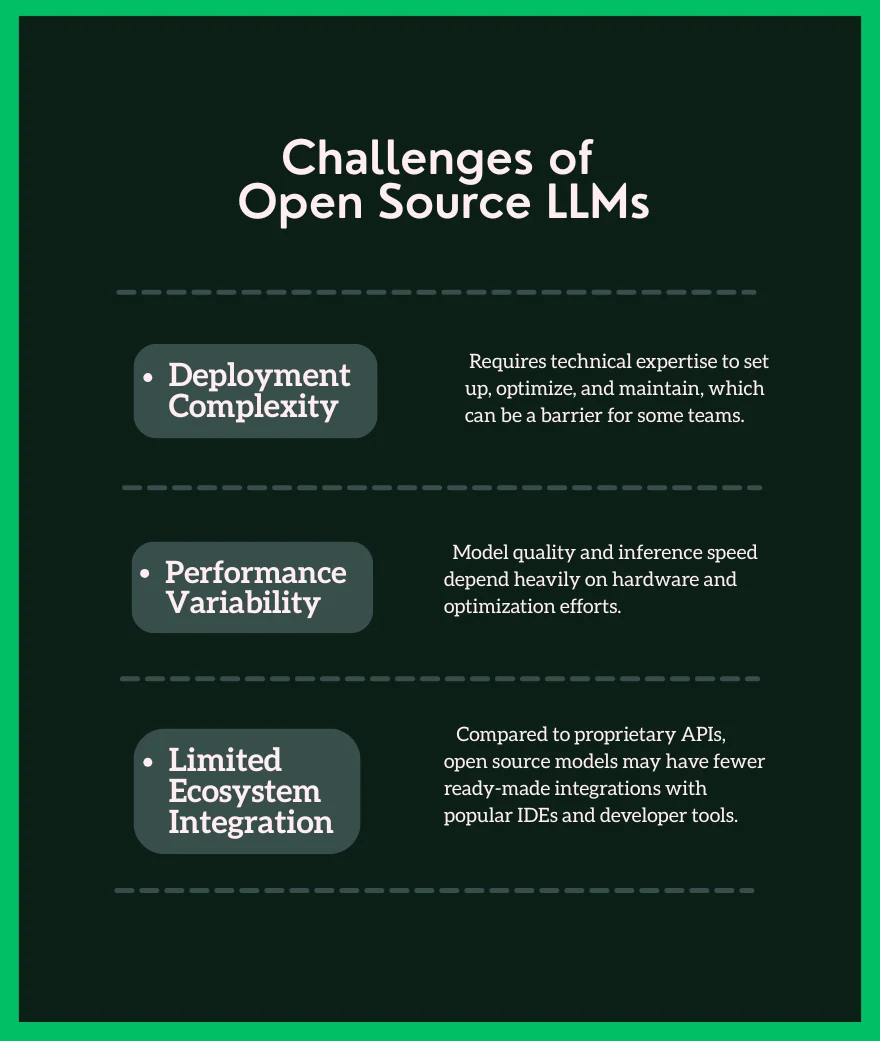
Challenges of Open Source LLMs
Representative Open Source Models
- Meta AI’s Llama Series:
Developed by Meta AI, the Llama family (e.g., Llama 4 Maverick) is known for efficiency, open weights, a large community, and fast inference. Newer Llama 4 models reportedly introduce massive context window potential. They are available with community licenses and via numerous API providers.
- DeepSeek Models:
DeepSeek AI’s models (e.g., DeepSeek R1, V3) are prominent contenders, recognized for a strong focus on reasoning and coding capabilities, with excellent performance on math benchmarks. They utilize Mixture-of-Experts (MoE) architectures, support generous context windows, and are available under permissive MIT licenses via API providers with competitive pricing.
- Alibaba Cloud’s Qwen Models:
The Qwen family from Alibaba Cloud (e.g., Qwen3 235B) demonstrates strong performance across various benchmarks including coding, mathematics, and reasoning, competing with proprietary models. They are highlighted for proficiency in Python and handling long context, support multiple languages, and are available with permissive licenses and via API.
3. Proprietary LLM APIs for Coding
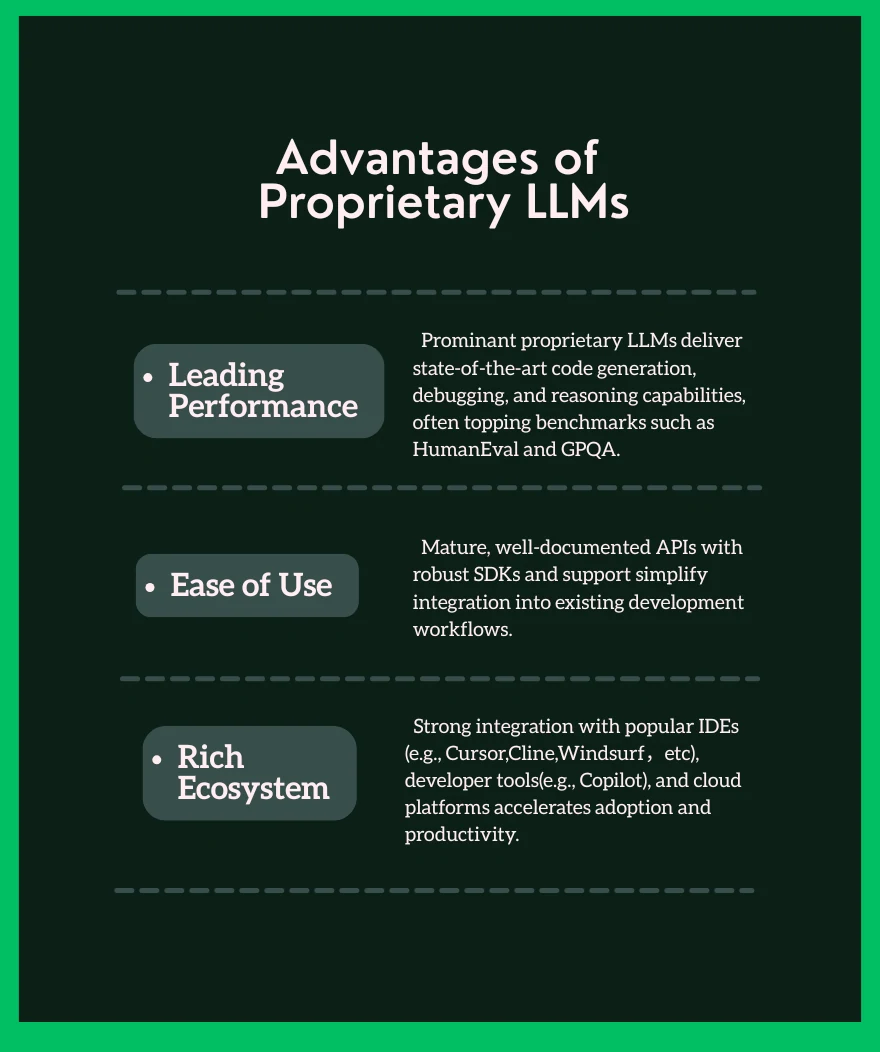
Advantages of Proprietary LLMs
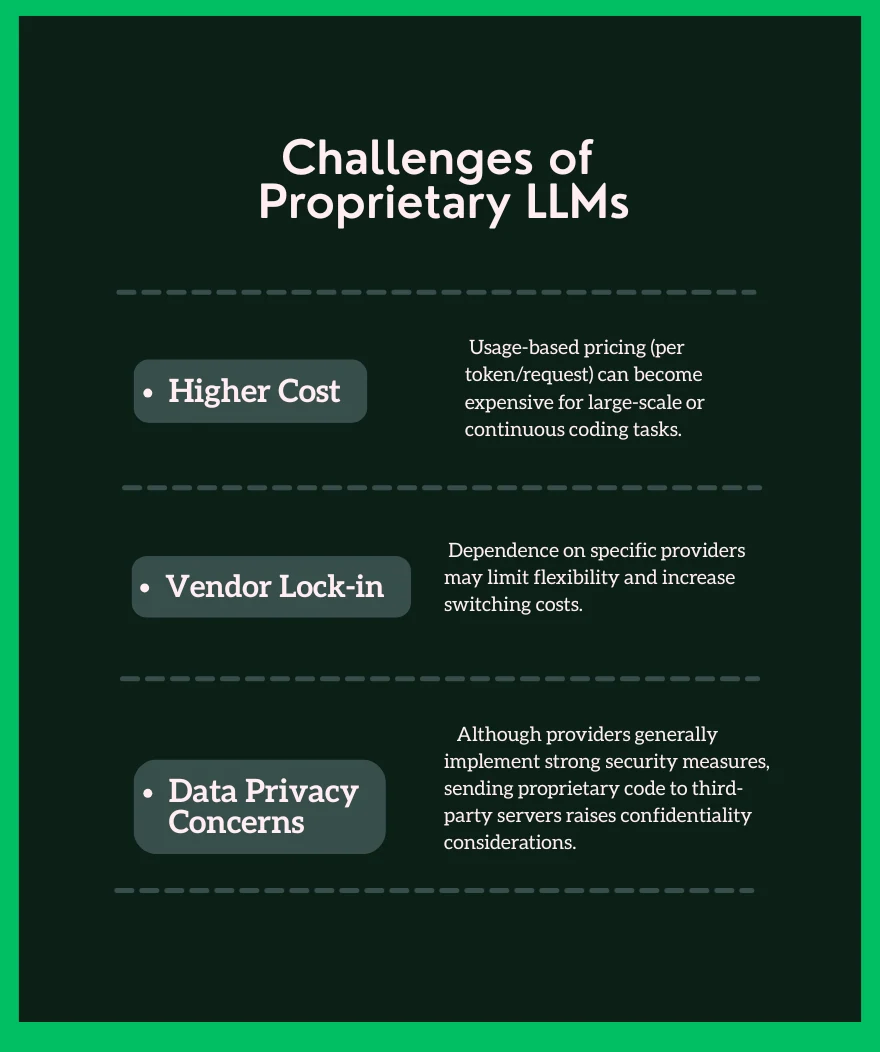
Challenges of Proprietary LLMs
Representative Proprietary Models
- OpenAI GPT Series
Developed by OpenAI, OpenAI GPT series (e.g., GPTo4-mini,o3) are widely recognized as powerful general-purpose models, famous for their conversational abilities, such as those supporting ChatGPT. They assist with a variety of tasks including answering questions and engaging in interactive dialogues.
- Anthropic Claude
Developed by Anthropic, Claude models(e.g.,Claude 4 Opus,Claude 4 Sonnet) emphasize AI safety and reliability. They are known for outstanding performance on complex tasks and offer APIs and chat interfaces for multiple uses such as summarization, search, writing, Q&A, and coding. Early user reports suggest Claude is less likely to produce harmful outputs and is easier to converse with and control.
- Google Gemini
Developed by Google, the Gemini series (e.g.,Gemini 2.5 Pro) are multimodal models that have quickly caught up and lead certain performance benchmarks. They are known for exceptional reasoning capabilities and handling large-scale context. Gemini models are accessible via Google AI Studio and Google Cloud Vertex AI.
4. How to Choose LLM API for Coding
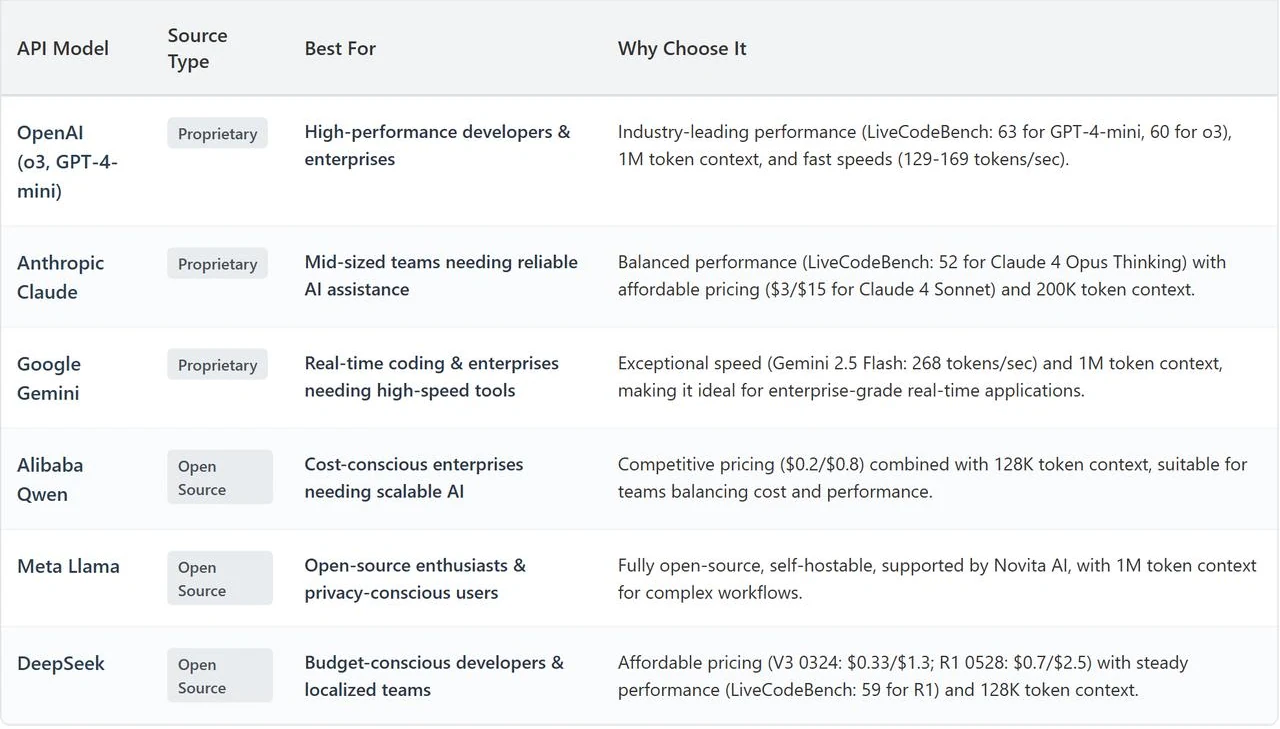
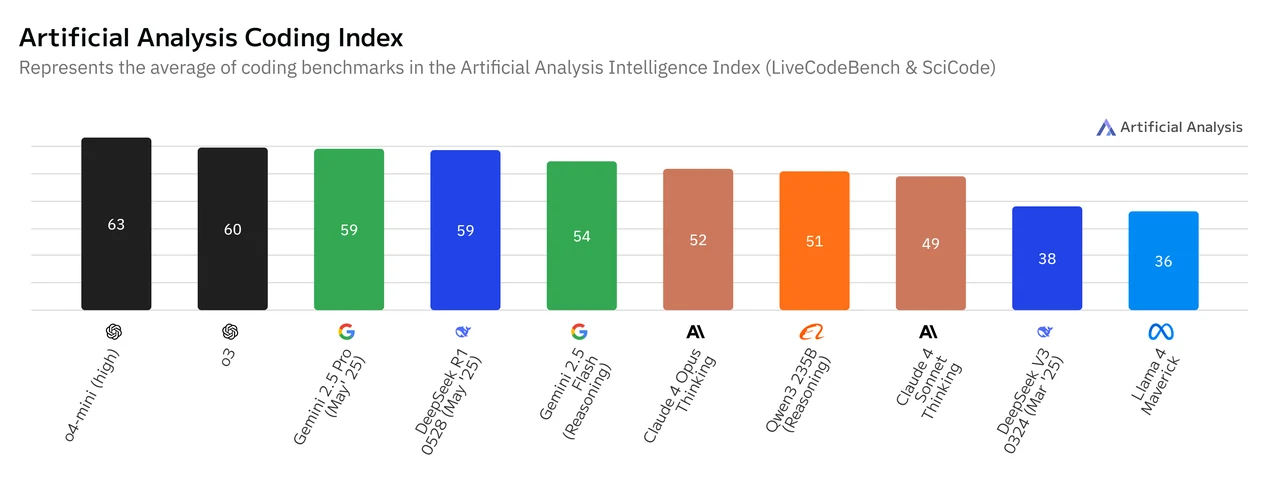
Selecting the optimal LLM API for coding involves balancing multiple critical factors that directly impact your development efficiency, cost, and overall user experience. Based on the latest market landscape and model benchmarks (see the comparison table above), these are the Artificial Analysis coding index:
And key metrics comparison of top coding LLM APIs:
| Factor | OpenAI (ChatGPT) Models | Anthropic Claude Models | Google Gemini Models | Alibaba Cloud’s Qwen Models | Meta AI’s Llama Series | DeepSeek Models |
| Coding Performance(LiveCodeBench&SciCode) | GPTo4-mini(high):63 o3:60 | Claude 4 Opus: 52 Claude 4 Sonnet: 49 | Gemini 2.5 Pro: 59 Gemini 2.5 Flash:54 | Qwen3 235B:51 | Llama 4 Maverick: 36 | Deepseek R1:49 Deepseek V3:38 |
| Price (Input / Output per 1M tokens) | GPTo4-mini(high):$1.1 / $4.4 o3: $10 / $40 | Claude 4 Sonnet: $3 / $15 Claude 4 Opus: $15 / $75 | Gemini 2.5 Pro: $1.25 / $10 Gemini 2.5 Flash: $0.15 / $3.5 | Qwen3 235B:$0.2/$0.8 | Llama 4 Maverick: $0.17/$0.85 | DeepSeek V3 0324: $0.33/ $1.3 DeepSeek R1 0528: $0.7 / $2.5 |
| Integration | Easy-to-use API, enterprise-grade support, Helicone integration | Easy-to-use API, enterprise-grade support, Helicone integration | Easy-to-use API, enterprise-grade support | API access, rapidly growing ecosystem | Open-source, requires self-hosting,supported by Together AI | Open-source, requires self-hosting,supported by Novita AI |
| Context Length | 200K tokens | 200K tokens | 1M tokens | 128K tokens | 1M tokens | 128K tokens |
| Speed (tokens/sec) | GPTo4-mini(high): 129 o3: 169 | Claude 4 Sonnet Thinking:63 Claude 4 Opus Thinking:57 | Gemini 2.5 Pro: 146 Gemini 2.5 Flash: 268 | Qwen3 235B:70 | Llama 4 Maverich:167 | DeepSeek V3: 24 DeepSeek R1: 24 |
Key Metrics for Evaluating Coding LLM APIs
Performance
The primary factor for choosing a coding LLM API is its ability to generate accurate, bug-free, and contextually relevant code. High performance minimizes debugging time and accelerates development.
For example, OpenAI’s GPTo4-mini leads the competition with a LiveCodeBench score of 63, closely followed by Google Gemini 2.5 Pro (59) and Deepseek R1(59). In contrast, open-source models like Meta Llama 4 Maverick (36) and DeepSeek V3 (38) may not match the proprietary models in accuracy but still offer solid performance for specific use cases.
Cost and Value
API pricing varies widely, making it essential to balance cost with performance, especially for large-scale or continuous usage. OpenAI’s GPTo4-mini is competitively priced at $1.1/$4.4 per 1M tokens, offering industry-leading performance.
On the other hand, DeepSeek V3 provides a budget-friendly alternative with pricing as low as $0.33/$1.30 per 1M tokens, making it an attractive option for startups or cost-sensitive developers. Proprietary models like Claude 4 Opus may be more expensive ($15/$75 per 1M tokens) but justify the cost with robust debugging and reasoning capabilities.
Integration and Ecosystem Support
Seamless integration with development workflows is crucial for productivity. Top LLM APIs have achieved excellent ecosystem support. OpenAI, Anthropic, and Google lead with enterprise-grade integration capabilities and extensive third-party tool support. Open-source models like DeepSeek, Qwen and Llama easily integrate through platforms like Novita AI into popular development environments such as Cursor and Cline. This standardization allows developers to switch between different models while maintaining consistent workflow integration.
Context Length
The model’s context window determines how much code or documentation it can process at once, which is crucial for handling large files or complex projects. Google Gemini 2.5 Pro dominates with a 1M token context, ideal for enterprise-scale projects. Meanwhile, DeepSeek and Alibaba Qwen 3 235B offer 128K tokens, which may suffice for smaller or simpler tasks.
Response Speed
Fast response times enhance the developer experience by reducing wait times during code generation or suggestions. Proprietary models like Google Gemini 2.5 Flash lead the market with 268 tokens/sec, making it a top choice for real-time coding workflows. Meanwhile, OpenAI o3 performs well at 169 tokens/sec, balancing speed and accuracy. Open-source models like DeepSeek V3 lag behind at 24 tokens/sec, which may affect workflows requiring quick results.
Summary
When evaluating coding LLM APIs, consider the following trade-offs based on your needs:
- For top-tier performance and speed, O penAI GPTo4-mini and Google Gemini 2.5 Pro stand out.
- For budget-friendly options, Qwen3 235B and DeepSeek V3 offers reasonable performance at a fraction of the cost.
- For customization and control, Meta Llama is ideal for privacy-conscious teams.
- For enterprise-grade integration, proprietary models like Anthropic Claude and OpenAI simplify adoption with extensive ecosystem support.
By carefully weighing these factors, you can select the most suitable API for your development goals.
Access the models we’ve discussed through one simple API FOR FREE!
5. How to Select the Right LLM API Provider
Choosing a single, reliable API provider can greatly simplify your AI integration journey. Leading providers such as OpenAI, Anthropic, Google, and Novita AI offer access to a diverse portfolio of LLM models optimized for various coding tasks, performance levels, and budget constraints. This flexibility enables you to seamlessly switch between models as your project requirements evolve without the need to overhaul your integration stack.
Why Novita AI ?
1. Service Reliability with Tiered SLAs
- Public API / Serverless Endpoints: Ideal for lightweight, scalable use cases, these endpoints deliver flexibility making them perfect for experimentation and non-critical applications.
- LLM Dedicated Endpoints: Designed for enterprise-grade reliability, these endpoints come with a 99.5% SLA, ensuring high availability and performance for production environments.
2. Cost Efficiency with Flexible Pricing
Novita AI’s pricing aligns with usage patterns, offering budget-friendly options for Serverless Endpoints and volume discounts for Dedicated Endpoints. For example:
- deepseek-r1-0528-qwen3-8b: Offers an extremely low cost of $0.06 per 1M tokens (input) and $0.09 per 1M tokens (output), making it ideal for cost-sensitive projects.
- llama-4-maverick-17b-128e-instruct-fp8: Provides 1,048,576 tokens of context at just $0.17 per 1M tokens (input) and $0.85 per 1M tokens (output), perfect for handling large-scale tasks with impressive cost-efficiency.
3. Rich Ecosystem Collaboration
Novita AI offers seamless integration with a wide range of third-party platforms and tools, enabling developers to enhance workflows and accelerate adoption:
-
Hugging Face Integration:Leverage Novita AI endpoints directly in Hugging Face Spaces, pipelines, or the Transformers library to deploy and experiment with LLM models efficiently. This integration simplifies model usage for both research and production environments.
-
Agent & Orchestration Frameworks:Easily connect Novita AI with popular frameworks such as Continue, AnythingLLM, LangChain, Dify, and Langflow. Official connectors and detailed integration guides ensure a smooth setup, allowing developers to orchestrate complex workflows with ease.
-
OpenAI-Compatible API:Novita AI supports tools like Cline and Cursor, designed to adhere to the OpenAI API standard. This compatibility guarantees a hassle-free migration for teams transitioning from OpenAI, enabling them to maintain existing workflows with minimal disruption.
4. Simplified Vendor Management
By consolidating your AI needs with Novita AI, you reduce the complexity of managing contracts, billing, and support, allowing teams to focus on innovation rather than operational overhead.
By choosing Novita AI, you gain a trusted partner that not only provides cutting-edge AI models but also delivers the operational support and scalability your projects demand.
Making the Right Choice
Ready to put these insights into practice? Skip the complex setup processes and start coding with AI in under 5 minutes. T ry the LLM demo on Novita AI now and claim your free credits !
Frequently Asked Questions
Is there a free LLM API to use?
Yes, there are free LLM (Large Language Model) APIs available, especially open-source options like Meta’s Llama and DeepSeek. These models themselves are free to use, but hosting and infrastructure costs may apply. Novita AI specialize in providing support for integrating and hosting open-source LLMs, ensuring cost-effective and scalable solutions tailored to specific needs.
What is LLM coding?
LLM coding refers to using Large Language Models to assist or automate coding tasks, such as generating code snippets, debugging, or even documenting projects. These models, like OpenAI’s GPT-4, are transforming the way developers work by increasing productivity and reducing errors.
What is the best LLM for code generation?
The best LLM for code generation depends on your specific needs, such as accuracy, cost, and scalability. OpenAI’s GPTo4, Google’s Gemini and DeepSeek are all excellent choices.
About Novita AI
Novita AI is an AI cloud platform that offers developers an easy way to deploy AI models using our simple API, while also providing the affordable and reliable GPU cloud for building and scaling.