On November 12 and 13, 2026, Novita hosted a booth at SGLang Summit 2026 at Fort Mason in San Francisco. The theme was “Open Foundations for the Next Era of AI,” and the expo floor brought serving systems, hardware, and the environments agents run in into one room. For Novita, the summit was a vantage point on a partnership that has moved from GPU infrastructure toward the layer where agents act.
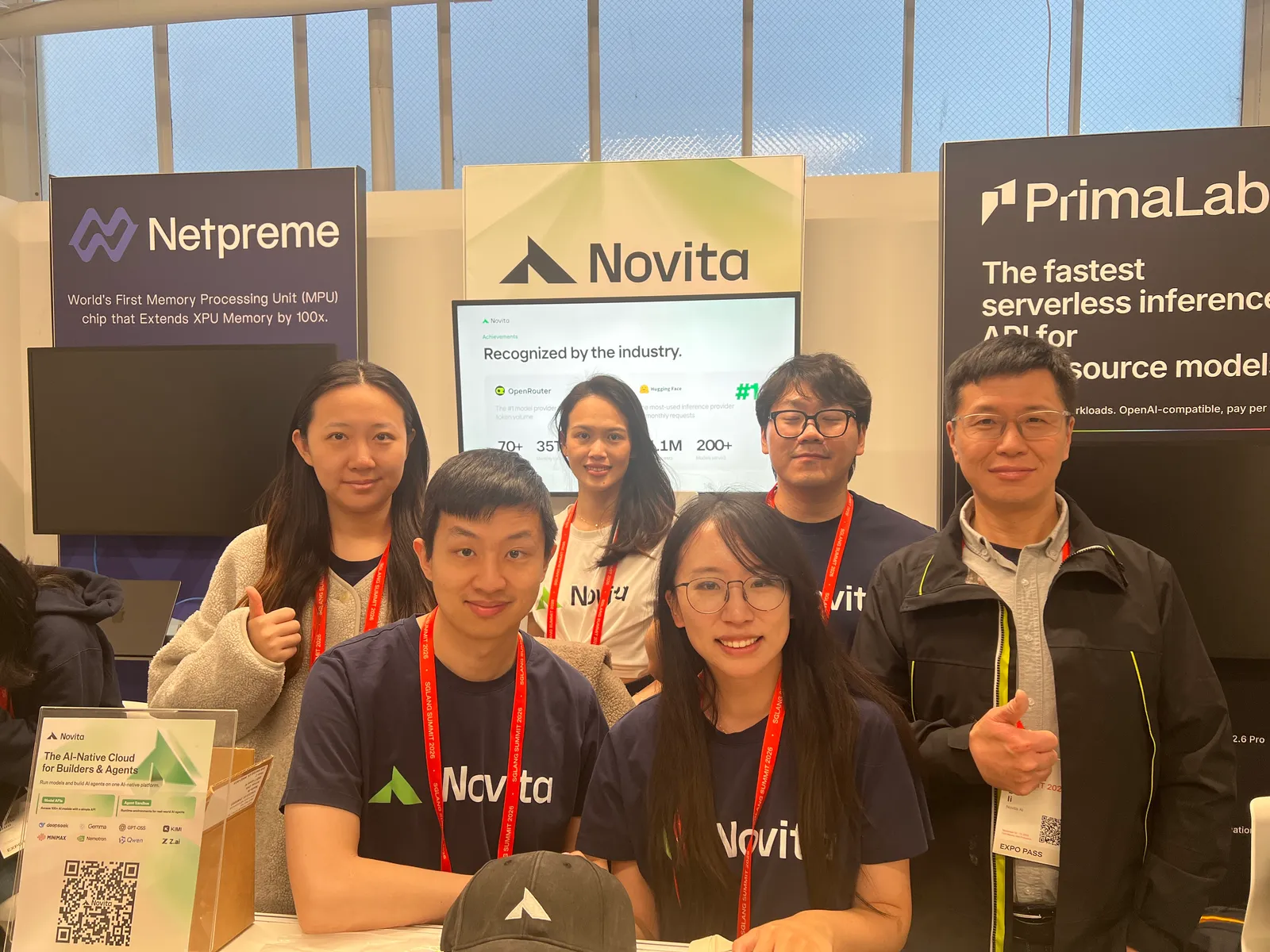
A group photo at the Novita booth during SGLang Summit 2026.
The partnership, from compute outward
Novita’s collaboration with SGLang dates to 2025, when the two announced a strategic partnership. Novita pledged high-performance GPU cloud resources for SGLang’s research, benchmarking, and optimization, and described its contribution as infrastructure and expertise: support for the development of SGLang’s first end-to-end multi-turn reinforcement learning framework and Prism, a multi-large-language-model serving system, plus collaboration on SGLang’s large-scale expert parallelism project, an open-source implementation designed to approach the throughput benchmarks described in DeepSeek’s official blog.
What the work produced
The collaboration has since produced results in production inference. Novita’s engineering guide to GLM4-MoE production optimization documents a set of SGLang-based changes for GLM-4.7, a mixture-of-experts model: shared-expert fusion adapted from earlier DeepSeek work, a QK-norm fusion built on Qwen-MoE, asynchronous transfer for prefill-decode disaggregation, and suffix decoding for agentic coding.
The benchmark uses agentic coding workloads on H200 clusters in TP8 and FP8 configurations, with 4096-token inputs, 1000-token outputs, and 14 requests per second on GLM-4.7 FP8. In that setup, TTFT fell by up to 65% and TPOT by 22%. The TPOT figure is specific to suffix decoding on top of MTP: mean TPOT fell from 25.13 ms to 19.63 ms. Novita says the optimizations are production-tested and running in its own inference service.
Sandbox in Miles
The partnership’s current chapter extends the same stack outward. Miles is the agentic reinforcement learning framework in the SGLang ecosystem, using SGLang for rollout generation and Megatron-LM for policy updates. Novita Sandbox supplies the task execution environment for each agent episode: where a shell command runs, where files change, and where the result returns to the model. The sandbox does not generate tokens or update weights.
Novita is listed as a sandbox provider in Miles’ sandbox documentation, with two experimental recipes: Harbor trials and the Terminal-Bench-2 OpenEnv path. They are experimental recipes rather than a hosted Novita service. In the OpenEnv path, the recipe builds a template per task, starts one sandbox per episode, waits for the environment server to become healthy, then lets the policy issue commands and feeds the results back; the sandbox is destroyed when the episode ends. Switching providers takes one variable per recipe, OPENENV_SANDBOX_BACKEND=novita or HARBOR_ENV_TYPE=novita, plus a NOVITA_API_KEY.
The sandbox replaces the execution environment, not the training side: you still need a working Miles installation with the model and GPU environment prepared. Miles’ other connectors, including HUD, NeMo Gym, and Verifiers, are outside this integration, and Novita has published no performance numbers for this path.
Back at the summit
At the booth, the arc became tangible: GPU resources for research in 2025, production work on GLM-4.7 in between, and now an execution environment for agent episodes. Novita presented Agent Sandbox for isolated execution and long-running agent tasks alongside model APIs for LLMs and multimodal models, under the banner “The AI-Native Cloud for Builders & Agents.”
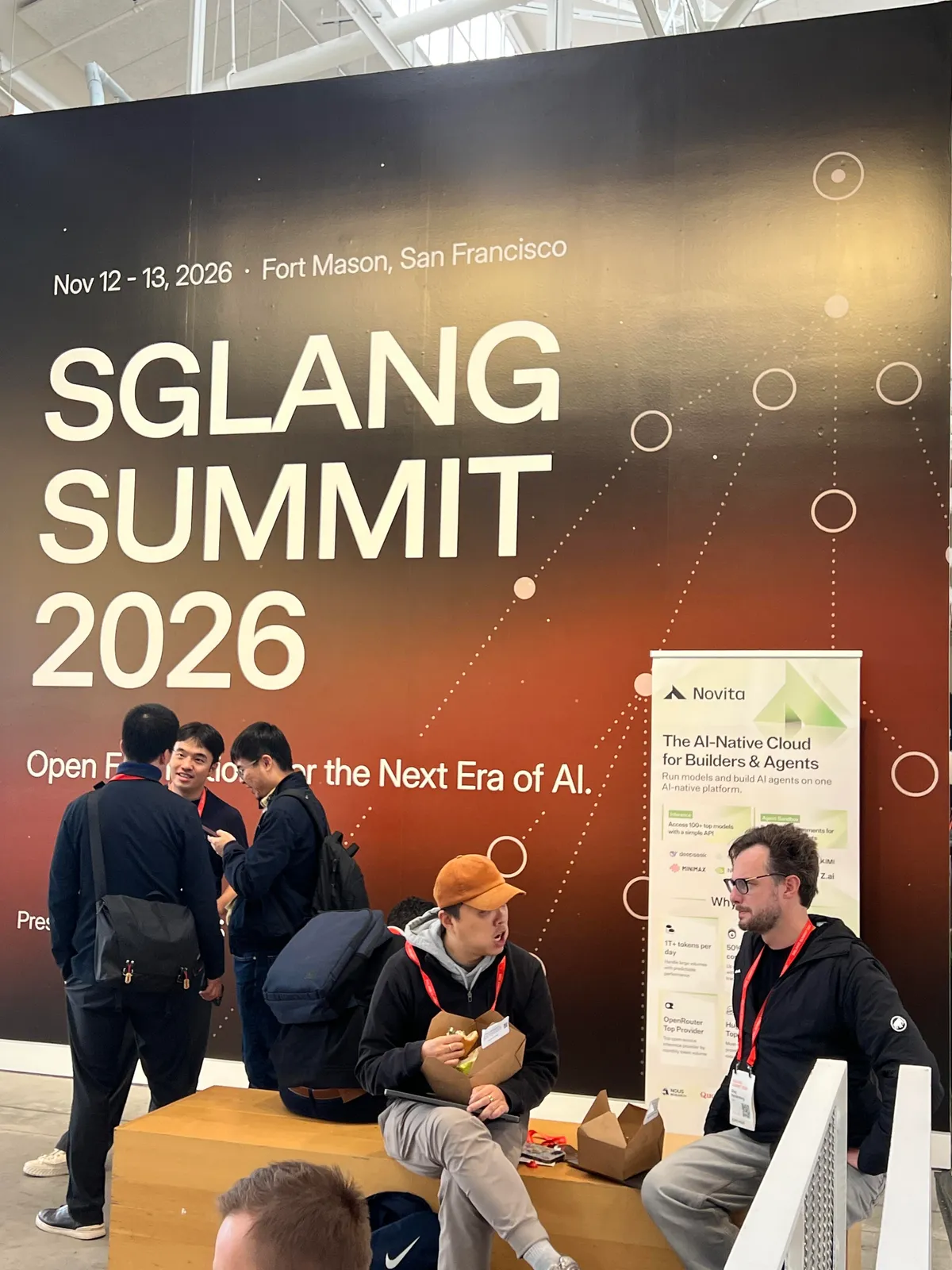
On the expo floor at SGLang Summit 2026, Fort Mason, San Francisco.
Thank you to everyone who stopped by the Novita booth.
Conclusion
The Novita–SGLang partnership has grown in scope without changing its shape. Novita supplies infrastructure and engineering support; SGLang supplies the serving and training stack; and the work has moved outward from compute to the runtime where agents execute. The summit put each stage in one room. If you are running agentic RL on SGLang, start with Novita Sandbox and read the Miles integration guide.
FAQ
What did Novita and SGLang announce in 2025?
In May 2025, Novita announced a strategic partnership with SGLang and said it would provide high-performance GPU cloud resources for SGLang’s research, benchmarking, and optimization. Novita described its role as supporting the development of SGLang’s multi-turn RL framework and the Prism multi-LLM serving system, and as collaborating on SGLang’s large-scale expert parallelism project. The original announcement covers the full scope.
What results has Novita reported for GLM-4.7 on SGLang?
Novita’s engineering guide reports up to 65% lower TTFT and 22% lower TPOT under agentic coding workloads, measured on H200 clusters in TP8 and FP8 configurations. The suffix-decoding result moved mean TPOT from 25.13 ms to 19.63 ms against an MTP baseline. The optimization write-up lists the benchmark configuration and launch flags.
How does Novita Sandbox fit into Miles?
It provides the per-episode task execution environment. SGLang handles rollout generation and Megatron-LM handles policy training; the sandbox does not generate tokens or update weights. Novita is listed as a provider for two experimental recipes, Harbor and OpenEnv, selected with OPENENV_SANDBOX_BACKEND=novita or HARBOR_ENV_TYPE=novita plus a NOVITA_API_KEY. Novita Sandbox is the product page.
Sources
- SGLang Summit 2026
- Novita AI partners with SGLang
- Optimizing GLM4-MoE for production
- Miles sandbox providers
- Novita docs: Miles integration
- Novita: How Sandbox powers Miles recipes