GLM-4.7 is Z.AI’s latest flagship LLM, built for production-grade workflows: multi-step reasoning, agentic coding, and tool use—without sacrificing the long-context experience developers rely on.
This post is a practical GLM-4.7 API evaluation. We’ll cover what GLM-4.7 is good at, where it’s most useful, and how to start using the GLM-4.7 API quickly—especially via Novita AI’s serverless, pay-per-token, OpenAI-compatible endpoint.
GLM-4.7 Performance
Benchmark results suggest GLM-4.7’s strongest improvements show up in agentic workflows, tool use, and end-to-end coding—exactly where API-driven apps are most sensitive.
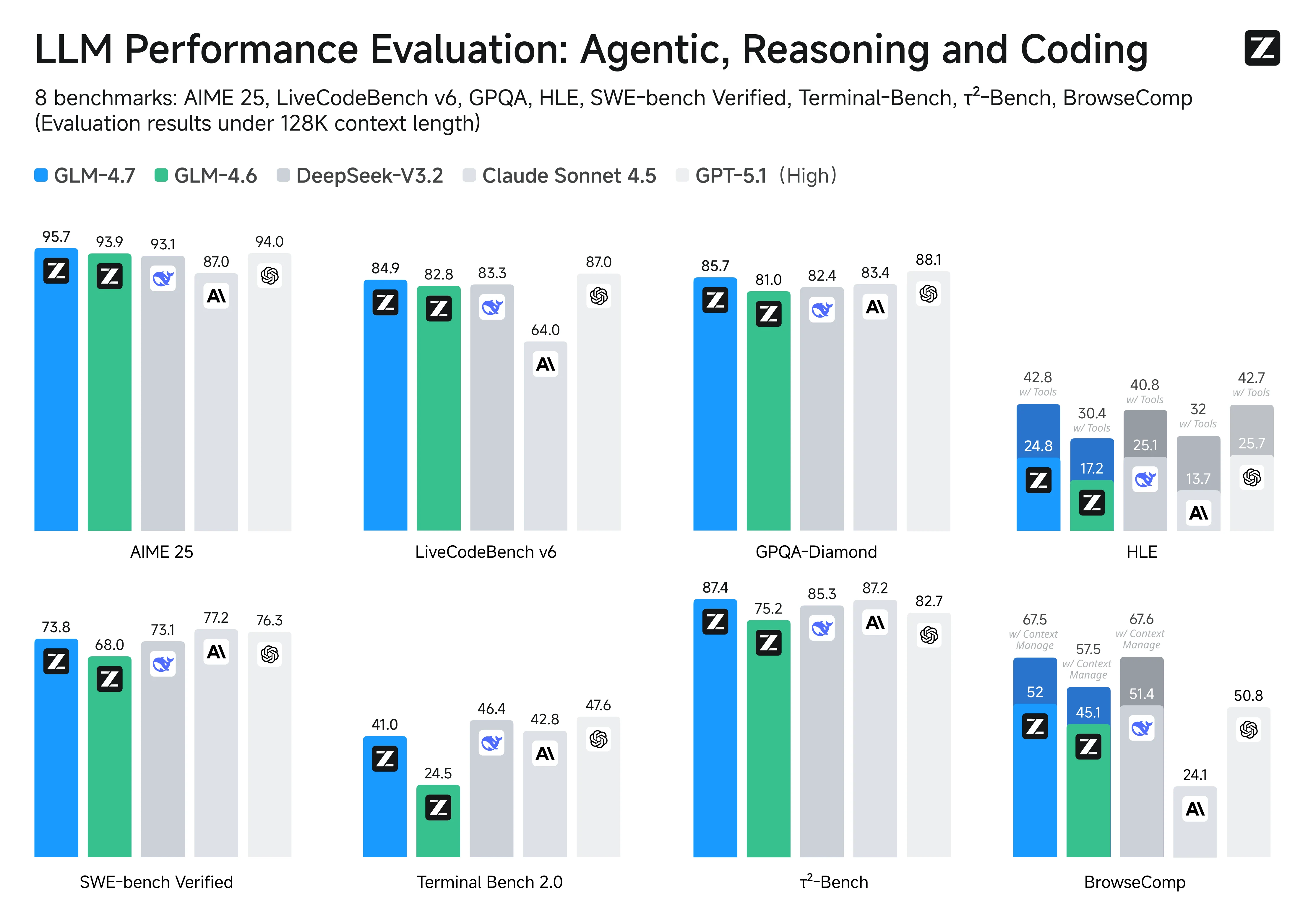
| Category | Benchmark | GLM-4.7 Score |
| Tool use & agent workflows | τ²-Bench | 87.4 |
| BrowseComp (w/ Context Manage) | 67.5 | |
| Coding reliability | SWE-bench Verified | 73.8 |
| Terminal-style agent execution | Terminal Bench 2.0 | 41 |
| Hard reasoning with tools | HLE (w/ Tools) | 42.8 |
💡 What It’s Good At
Long context: It leads BrowseComp both in base score and with context management, indicating strong performance on long documents, web browsing, and multi-source synthesis.
Reasoning: GLM-4.7 tops AIME 25 in this group, signaling stronger high-difficulty math and logic performance than other peers.
Coding: GLM-4.7 achieves 73.8 on SWE-bench Verified, leading the open models shown in the chart.
Agents & tools: GLM-4.7 makes a major jump on TerminalBench 2.0 and reaches the ceiling on HLE with tools, which is exactly what you want for agents that must operate tools and complete multi-step tasks.
Why the GLM-4.7 API Story Matters: Open vs. Closed Models
When people say “Open Source models,” they often mean open-weight models: model weights are available, enabling more control and portability. “Closed models” typically mean models only accessible through a single provider’s API.
Why builders choose open models
Open models are attractive because they can offer:
- Control & reproducibility: version pinning and consistent behavior over time
- Portability & optionality: flexibility for multi-vendor strategies or future self-hosting
- Governance flexibility: depending on your org, open models can simplify internal reviews and deployment constraints
Why closed models are still popular
Closed models can offer:
- Turnkey experience: strong packaging and tooling
- Centralized iteration: improvements can roll out quickly
Key takeaway: If an open model like GLM-4.7 is leading in a human preference leaderboard, it’s a strong signal that open models can compete on ship-ready output quality, not just cost.
❓Now the practical question becomes: How do you get the benefits of open models while keeping integration simple?
➡ That’s where Novita comes in.
Why Use Novita API
Novita helps teams ship open models faster by providing:
- OpenAI-compatible API (easy integration with existing SDKs and tooling)
- Serverless inference (no hosting, scaling, or GPU ops required)
- A unified way to call popular open models, including GLM-4.7
If your team wants to adopt open models but doesn’t want to run infrastructure, Novita makes it straightforward to go from evaluation → prototype → production.
Model capabilities (GLM-4.7 on Novita)
- Context length: 204,800 tokens
- Max output: 131,072 tokens
- Supports function calling, structured output, and reasoning
🙌Ready to try it? GLM-4.7 on Novita is priced at $0.60 / 1M input tokens and $2.20 / 1M output tokens. For current pricing (and any promotional updates), see the Novita pricing page.
Access GLM-4.7 via Novita
Step 1: Log In and Access the Model Library
Log in (or sign up) to your Novita AI account and navigate to the Model Library.
Step 2: Choose GLM-4.7
Browse the available models and select GLM-4.7 based on your workload requirements.
Step 3: Start Your Free Trial
Activate your free trial to explore GLM-4.7’s reasoning, long-context, and cost-performance characteristics.
Step 4: Get Your API Key
Open the Settings page to generate and copy your API key for authentication.
Step 5: Install and Call the API (Python Example)
Below is a simple example using the Chat Completions API with Python:
from openai import OpenAI

client = OpenAI(
    api_key="<Your API Key>",
    base_url="https://api.novita.ai/openai"
)

response = client.chat.completions.create(
    model="zai-org/glm-4.7",
    messages=[
        {"role": "system", "content": "You are a helpful assistant."},
        {"role": "user", "content": "Hello, how are you?"}
    ],
    max_tokens=131072,
    temperature=0.7
)

print(response.choices[0].message.content)
This setup allows you to control reasoning depth, token usage, and generation behavior—particularly useful when leveraging turn-level thinking to manage cost and latency.
Conclusion
Design Arena’s biggest value is that it turns subjective quality into measurable signals through human preference voting. In the Open Source leaderboard, GLM-4.7’s leading rating indicate it’s a strong option for teams who care about ship-ready generative output quality while keeping open-model flexibility.
If you want to put GLM-4.7 into production fast, Novita’s OpenAI-compatible API lets you integrate quickly with minimal code changes—while giving you long context, large outputs, and structured features that fit modern application workflows.
Frequently Asked Questions
What is GLM 4.7?
GLM-4.7 is Z.ai’s flagship LLM, positioned for enhanced programming and more stable multi-step reasoning/execution, and it is released with an official open-weights model (available on Hugging Face).
What is the GLM-4.7 API used for?
GLM-4.7 API is commonly used for agent workflows, tool calling, and coding tasks that require long context and stable structured outputs.
How do I access the GLM-4.7 API quickly?
You can access GLM-4.7 through an OpenAI-compatible endpoint (e.g., Novita) using your API key and the Chat Completions API.
Novita AI is an AI cloud platform that offers developers an easy way to deploy AI models using our simple API, while also providing the affordable and reliable GPU cloud for building and scaling