Key Highlights
GPU Power in AI: GPUs are essential for accelerating matrix operations in AI, with significant impact on training time, batch size, and energy efficiency.
A100 vs. RTX 4080: The A100 is better for large-scale tasks, while the RTX 4080 excels in real-time applications.
Use Case Suitability: A100 is ideal for AI training, RTX 4080 for smaller models and real-time AI.
Cost and TCO: A100 offers long-term value for large operations, RTX 4080 is cost-effective for smaller projects.
Novita AI Cloud GPUs: Novita AI provides scalable cloud GPU services with A100 and RTX 4080 for efficient AI computing.
The AI hardware landscape in 2025 presents two compelling NVIDIA GPU options: the data center-focused A100 and the consumer-grade RTX 4080. These processors represent distinct approaches to accelerating machine learning workloads, each with unique advantages for different AI applications. As organizations navigate the balance between computational demands and budget constraints, understanding the nuanced capabilities of these GPUs becomes essential for informed decision-making. This comprehensive analysis delves into their architectural distinctions, performance metrics, and optimal use cases, helping you select the right GPU solution for your specific AI projects.
The Importance of GPU Power in AI
Modern AI models require unprecedented computational resources—large language models like GPT-4 Turbo demand over 320 GB of VRAM during training, while real-time inference applications need millisecond-level latency. GPUs accelerate matrix operations fundamental to neural networks, with architectural choices dramatically impacting:
- Training time for billion-parameter models
- Batch size capabilities in memory-bound tasks
- Energy efficiency at scale
- Total cost of ownership (TCO)
A100 vs RTX 4080: Architectural Overview
A100: Data Center-Optimized Design
Built on NVIDIA’s Ampere architecture, the A100 combines:
- 6,912 CUDA Cores + 432 Third-Gen Tensor Cores: Achieve 312 TFLOPS FP16 (624 TFLOPS with sparsity).
- 80 GB HBM2e Memory: Delivers 2,039 GB/s bandwidth via a 5,120-bit bus, enabling full-precision training of 70B-parameter models.
- Multi-Instance GPU (MIG): Partitions one GPU into seven isolated instances for multi-tenant cloud workloads.
- NVLink 3.0: Connects up to eight GPUs with 600 GB/s interlinks for linear scaling
RTX 4080: Consumer-Grade Performance
The Ada Lovelace architecture balances gaming and AI:
- 9,728 CUDA Cores + 304 Fourth-Gen Tensor Cores: Boosts to 48.7 TFLOPS FP32, ideal for mixed-precision inference.
- 16 GB GDDR6X: Offers 716.8 GB/s bandwidth but limits batch sizes for models >3B parameters.
- DLSS 3.0 + Ray Tracing: Repurposed for AI denoising and real-time rendering.
Performance Benchmarks: A100 vs RTX 4080 in AI Workloads
Computational Throughput
A100: Built on the Ampere architecture, the A100 boasts an impressive 312 TFLOPS of performance for FP16 operations, with the ability to hit 624 TFLOPS with sparsity. This makes the A100 an absolute powerhouse for heavy-duty computations like deep learning model training, where high throughput is essential. Its 432 Tensor Cores are specifically optimized for matrix operations, which are foundational for AI training tasks.
RTX 4080: The RTX 4080, based on the Ada Lovelace architecture, offers 48.7 TFLOPS for FP32, making it ideal for real-time tasks and AI inference. Though it offers lower throughput than the A100, it’s designed to balance both gaming and AI workloads, making it more versatile for a broader range of applications. With 304 Tensor Cores, the RTX 4080 handles mixed-precision tasks effectively, but it’s still behind the A100 when it comes to pure computational throughput.
Memory-Bound Tasks
The A100’s larger memory capacity (up to 80GB) and higher bandwidth make it superior for memory-intensive tasks like training large language models. The RTX 4080’s 16GB VRAM may require techniques like gradient checkpointing for larger models.
Framework-Specific Optimization
Both GPUs support major AI frameworks like TensorFlow and PyTorch. However, the A100 often sees better optimization in enterprise-focused distributions, while the RTX 4080 benefits from NVIDIA’s gaming-oriented driver optimizations.
Use Case Suitability: When to Choose A100 or RTX 4080
Scenarios Where A100 Excels
The A100 is ideal for:
- Large-scale AI training: It handles vast datasets and complex models, making it perfect for deep learning research, NLP tasks, and scientific computing.
- High-performance computing (HPC): Its massive computational power makes it suitable for physics simulations, weather modeling, and other data-intensive applications.
- Enterprise environments: A100 is built for the needs of data centers and large-scale cloud infrastructure, where performance, reliability, and scalability are essential.
Viable Applications for RTX 4080
The RTX 4080 excels in:
- AI development for professionals: Developers working on smaller AI models, training prototypes, and running inference tasks will find the RTX 4080 an affordable, high-performing option.
- Real-time AI applications: Its impressive speed makes it ideal for real-time tasks such as image recognition, autonomous vehicles, and AR/VR applications.
- Gaming and creative professionals: With its gaming roots, RTX 4080 is perfect for individuals working on AI-driven creative projects, including 3D rendering and animation.
Cost and Operational Considerations: A100 vs RTX 4080
Acquisition and Deployment
A100:
- Hardware cost: $10,000 - $15,000 per unit
- Cloud service: $1.60/hr (Novita AI)
- Requires data center infrastructure (cooling, power)
- Often deployed in multi-GPU configurations
RTX 4080:
- Hardware cost: $1,200 - $1,500 per unit
- Can be used in standard workstations
- Typically deployed as single units or small clusters
Total Cost of Ownership (TCO)
When considering TCO, factor in:
- Initial hardware costs
- Power consumption
- Cooling requirements
- Maintenance and support
- Software licensing
The A100 has a higher upfront cost but may offer better long-term value for large-scale AI operations. The RTX 4080 provides a more accessible entry point for smaller projects or organizations.
Choosing Novita AI for Cloud GPU Services
Novita AI leads the way in delivering advanced cloud-based GPU services, empowering businesses and researchers to harness high-performance computing for machine learning. By offering scalable and flexible access to state-of-the-art hardware, Novita AI enables the seamless processing of complex ML tasks without the need for significant upfront hardware investments. This is essential for driving innovation and streamlining model training.
To start using Novita AI, simply follow these steps:
Step1:Register an account
If you’re new to Novita AI, the first step is to create an account on our website. After registering, navigate to the “[GPUs](https://novita.ai/gpus/?utm_source=blogs_GPU&utm_medium=article&utm_campaign=A100 vs RTX 4080: Ultimate GPU Showdown for AI in 2025)” tab to explore the available resources and kickstart your journey.
[Try using Novita AI now](https://novita.ai/?utm_source=blogs_GPU&utm_medium=article&utm_campaign=A100 vs RTX 4080: Ultimate GPU Showdown for AI in 2025)
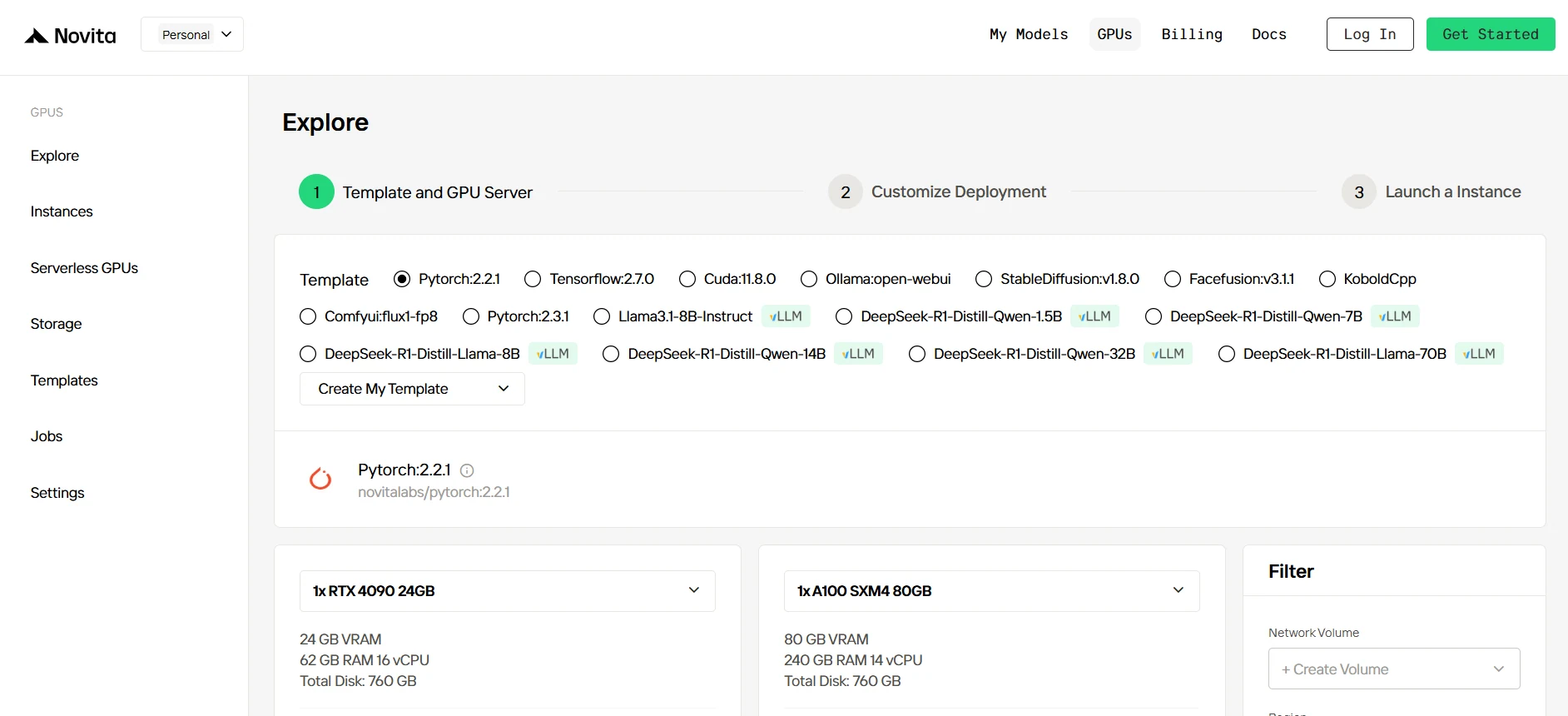
Step2:Exploring Templates and GPU Servers
Begin by selecting a template that aligns with your project requirements, such as PyTorch, TensorFlow, or CUDA. Choose the version that suits your needs, like PyTorch 2.2.1 or CUDA 11.8.0. Next, pick a GPU server configuration—options like the RTX 4090 or A100 SXM4 are available, each offering different VRAM, RAM, and disk capacities to meet the demands of your workload.
[Try Novita AI’s High-Performance GPUs](https://novita.ai/gpus-console/?utm_source=blogs_GPU&utm_medium=article&utm_campaign= A100 vs RTX 4080: Ultimate GPU Showdown for AI in 2025)
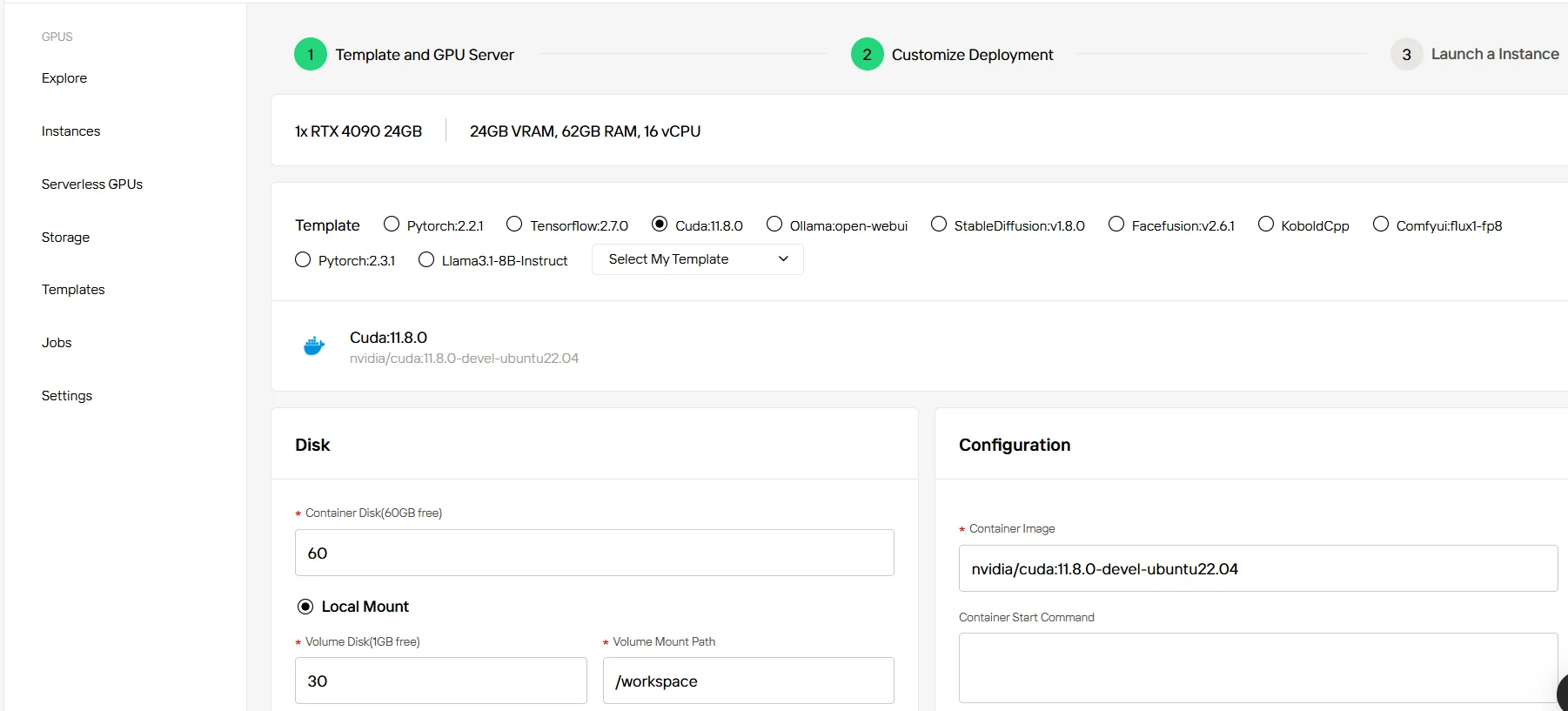
Step3:Tailor Your Deployment
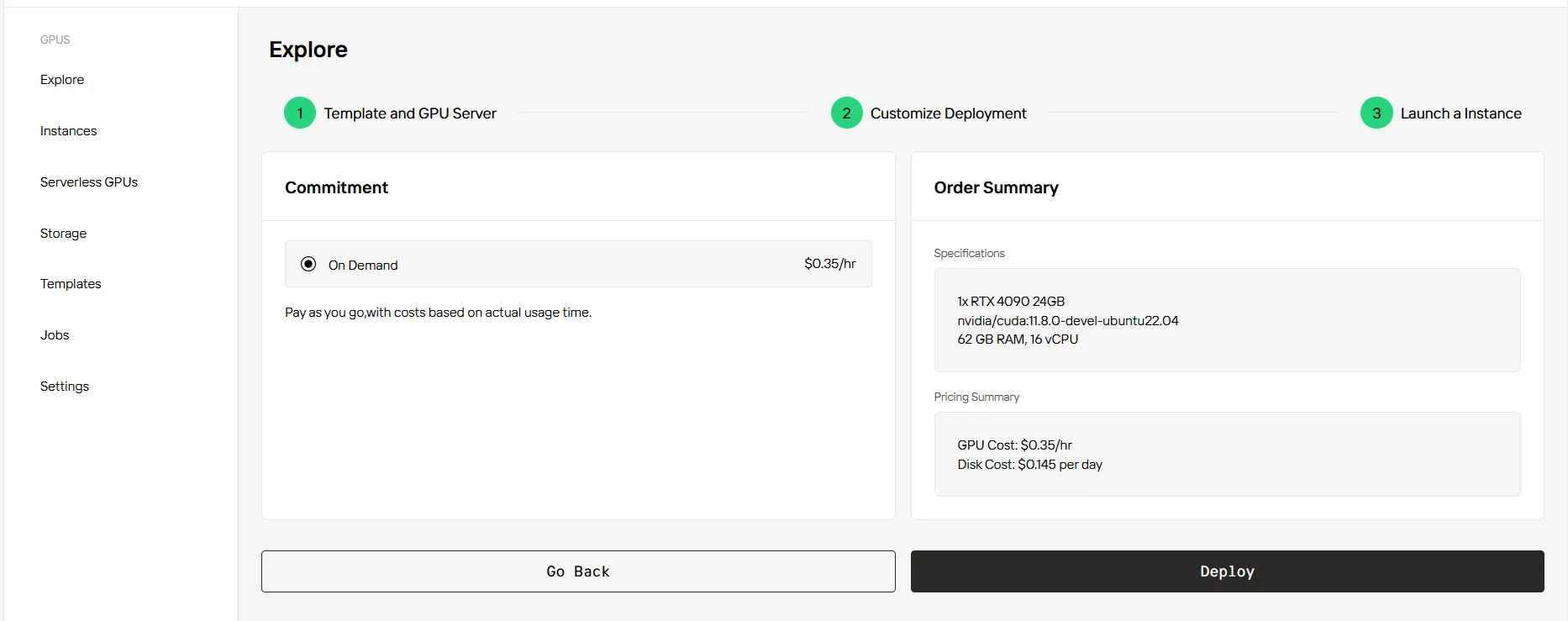
After selecting a template and GPU, you can customize your deployment settings. Adjust parameters such as the operating system version (e.g., CUDA 11.8) and tweak other configurations to fine-tune the environment to fit your project’s specific needs.
Step4:Launch an instance
Once you’ve finalized the template and deployment settings, click “Launch Instance” to set up your GPU instance. This will initiate the environment setup and enable you to start using the GPU resources for your machine learning tasks.
Conclusion
When selecting a GPU for AI projects, it’s essential to consider both performance needs and budget. The A100 stands out as the top choice for large-scale AI and enterprise deployments, offering unmatched performance for demanding tasks. On the other hand, the RTX 4080 provides a more cost-effective solution for smaller AI projects and research, delivering impressive capabilities at a lower price point. Ultimately, the right choice depends on the specific use case, budget constraints, and the desired performance level for your project.
Frequently Asked Questions
Can the RTX 4080 be used for AI inference tasks?
Yes, the RTX 4080 is suitable for AI inference, especially for small to medium-sized models. Its INT8 performance (390 TOPS) is adequate for tasks like running Stable Diffusion or BERT-base models with latencies under 100ms.
Will the A100 still be relevant for AI workloads in 2025?
Yes, the A100 will likely remain relevant for enterprise AI in 2025, especially for tasks requiring its FP64 capabilities and large memory capacity. However, for pure AI training, newer architectures like the H100 and future B100 (Blackwell) may offer superior performance. Smaller companies might shift towards more cost-effective options like the L40S or cloud services.
Which GPU is better for training large language models?
The A100 is significantly better for training large language models. Its 80GB of HBM2e memory can directly accommodate 70B+ parameter models, while the RTX 4080’s 16GB VRAM is insufficient for such large models without techniques like gradient checkpointing.
[Novita AI](https://novita.ai/?utm_source=blogs_GPU&utm_medium=article&utm_campaign= A100 vs RTX 4080: Ultimate GPU Showdown for AI in 2025) is an AI cloud platform that offers developers an easy way to deploy AI models using our simple API, while also providing a affordable and reliable GPU cloud for building and scaling.
Recommended Reading
What is GPU Cloud: A Comprehensive Guide